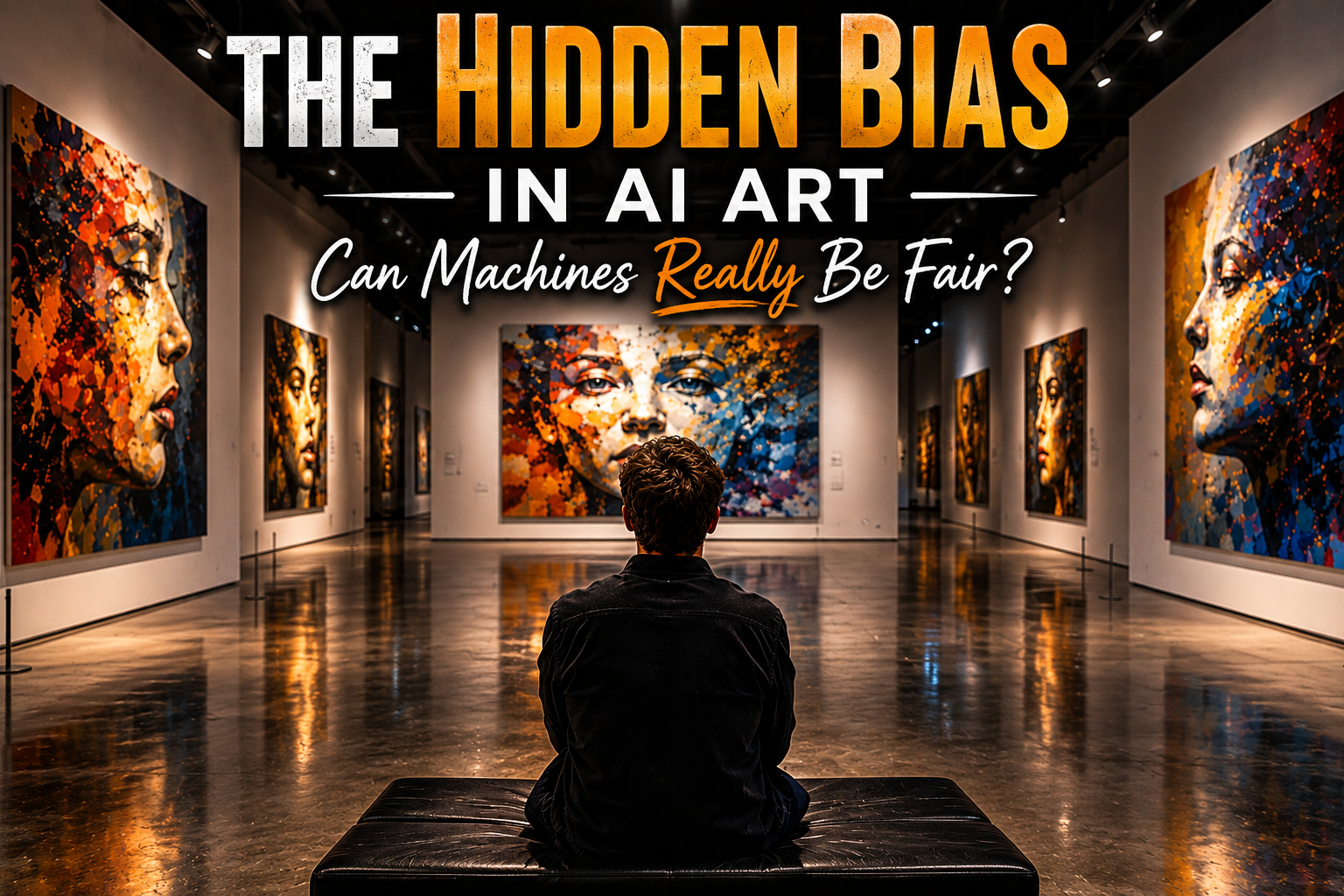
The Hidden Bias in AI Art: Can Machines Really Be Fair?
Artificial intelligence is changing creativity faster than almost anyone expected. What once sounded futuristic is now becoming part of everyday digital culture. AI can generate paintings, cinematic photography, illustrations, advertising concepts, album covers, digital fashion, architecture, animations, and entire visual worlds within seconds. Artists, creators, brands, and companies now use artificial intelligence to speed up workflows, generate ideas, and experiment with styles that previously required entire creative teams.
But behind the excitement surrounding AI art, a much deeper conversation is beginning to grow. Can machines actually be fair?
As artificial intelligence becomes more involved in modern creativity, people are starting to notice that these systems sometimes reflect stereotypes, cultural imbalances, and social biases already present in human society. The issue is not always obvious at first glance, but once people begin paying attention, the patterns become harder to ignore. Artificial intelligence does not create ideas in isolation. It learns from humanity itself. That means AI systems often absorb the same flaws, assumptions, and imbalances found across human history. The machine is not inventing bias. It is learning from the world people created.
Artificial Intelligence Learns From Human Behavior
One of the biggest misunderstandings people have about AI is believing the technology “thinks” like a human being. It does not. Artificial intelligence studies patterns. It predicts relationships between words, images, colors, concepts, and visual associations based on enormous amounts of data collected from the internet and digital archives.
If millions of online images repeatedly show certain professions, lifestyles, beauty standards, or cultural representations in similar ways, the AI learns those patterns as normal. For example, an AI image generator asked to create “a CEO” may often generate older men in suits. A request for “a nurse” may frequently produce women. A prompt about wealth may favor luxury Western imagery. Certain beauty-related prompts may unintentionally lean toward lighter skin tones or mainstream social media aesthetics because those patterns appear heavily across training data online.
The AI itself is not making moral choices. It is predicting probability. That distinction matters because it changes how people should think about responsibility. Artificial intelligence is not independently deciding who deserves representation. It is mirroring the patterns humans repeated often enough for the system to recognize them as dominant. In many ways, AI becomes a reflection of society itself. And society has never been perfectly neutral.
Bias Often Hides Inside the Data
Most AI systems are trained using massive datasets containing billions of images, captions, articles, artworks, and visual references gathered from the internet. That training process shapes everything the AI eventually creates.
If the majority of available data comes from Western countries, Western media, English-language content, and mainstream internet platforms, the AI naturally becomes stronger at reproducing those styles and perspectives. Meanwhile, underrepresented cultures, artistic traditions, languages, and communities may appear less frequently inside the data, making the AI less accurate or less nuanced when attempting to generate those experiences visually.
This imbalance is not always intentional. Sometimes certain perspectives simply dominate digital spaces more heavily than others. But the result still matters. Artificial intelligence quietly absorbs those imbalances and reproduces them through creative output.
Even language itself can influence bias. Small changes in wording can dramatically affect how AI interprets a prompt. Certain words may trigger assumptions about race, gender, age, attractiveness, intelligence, wealth, or professionalism because the system learned associations from historical patterns online. That means every AI-generated image carries traces of the information it was trained on. And human history contains both creativity and prejudice at the same time.
When AI Starts Influencing Creativity
The conversation becomes even more important because AI is no longer a niche tool used only by developers or researchers. Millions of creators now rely on artificial intelligence for concept art, advertising, branding, social media visuals, video thumbnails, fashion inspiration, digital storytelling, animation, website design, and entertainment production.
AI-generated visuals are becoming part of everyday internet culture. That creates an important question for the future. If artificial intelligence is trained mostly on existing trends and repeated visual patterns, does it actually expand creativity, or does it sometimes push creativity toward the same familiar ideas over and over again?
Some critics argue that AI systems can unintentionally flatten originality by favoring what already performs well online. Popular aesthetics become repeated more often. Certain styles dominate visibility. Certain faces, colors, and visual trends appear constantly because the algorithms learned them as “successful.” Over time, creativity itself risks becoming algorithmically predictable.
That possibility worries many artists. At the same time, other creators see opportunity inside the problem itself. Some artists intentionally use biased AI outputs as social commentary. They create projects exposing how machines interpret race, identity, beauty, gender, or power structures in ways that reveal hidden cultural assumptions. In that sense, AI art has become more than a creative tool. It has become a mirror.
The Ethical Responsibility of Creators
As artificial intelligence becomes more integrated into art and media, ethical awareness is becoming just as important as technical skill. Creators can no longer treat AI as a neutral black box. Every tool reflects values. Every dataset reflects history. Every algorithm reflects decisions made by human beings somewhere during development.
That means artists, designers, marketers, filmmakers, and digital creators now carry responsibility too. Using AI responsibly means asking difficult questions. Who built this system? What kind of data trained it? Whose perspectives appear inside the dataset? Whose perspectives are missing? Am I reinforcing stereotypes without realizing it? Am I using AI to broaden representation or narrow it?
These questions matter because AI-generated content now reaches millions of people every day through social media feeds, advertisements, websites, entertainment platforms, and digital products. Artificial intelligence is no longer sitting quietly in laboratories. It is shaping culture in real time. And culture influences how people see themselves and others. That makes ethics impossible to ignore.
Technology Is Reflecting Humanity Back at Us
One of the most fascinating parts of the AI conversation is realizing that artificial intelligence often reveals more about humanity than machines themselves. People sometimes expect AI to behave objectively because it is technological. But technology is still created by humans.
Human beings select the data. Human beings build the systems. Human beings define the priorities. Human beings decide what gets rewarded online. Artificial intelligence simply learns from those patterns at enormous scale.
That realization changes the conversation entirely. The problem is not only whether machines contain bias. The deeper issue is understanding how much bias already exists within society itself. AI is exposing patterns people often ignored before because the machine reproduces them so quickly and visibly. In many ways, artificial intelligence is forcing humanity to confront itself.
The Industry Is Trying to Improve
Fortunately, many companies and researchers are actively working to improve fairness inside AI systems. Major AI platforms continue refining datasets, adding moderation systems, increasing diversity training, and studying ways to reduce harmful outputs. Researchers now focus heavily on transparency, fairness testing, inclusive data collection, and ethical design practices.
Some systems allow users to adjust outputs for greater diversity. Others flag potentially harmful prompts or attempt to balance representation more carefully across generated images. Progress is happening.
But complete fairness may never fully exist. Artificial intelligence learns from human culture, and human culture itself contains centuries of imbalance, conflict, exclusion, and evolving social values. No dataset can erase history completely.
That is why awareness matters so much. The goal may not be building a perfect machine. The goal may be building more conscious humans using powerful technology responsibly.
The Future of AI Art Will Depend on Awareness
Artificial intelligence will continue transforming creativity over the next decade. AI-generated films, digital influencers, immersive worlds, advertising campaigns, virtual fashion, interactive storytelling, and automated visual design will become increasingly common across modern life. The line between human-made creativity and machine-assisted creativity will continue becoming harder to separate.
At the same time, conversations about ethics, fairness, representation, and cultural responsibility will become even more important. The future of AI art may not depend only on how advanced the technology becomes. It may depend on how thoughtful humanity becomes while using it.
Because in the end, artificial intelligence does not simply reveal what machines can create. It reveals what humans repeat, prioritize, reward, and believe. And sometimes the most powerful thing technology can do is force society to see itself more clearly than ever before.