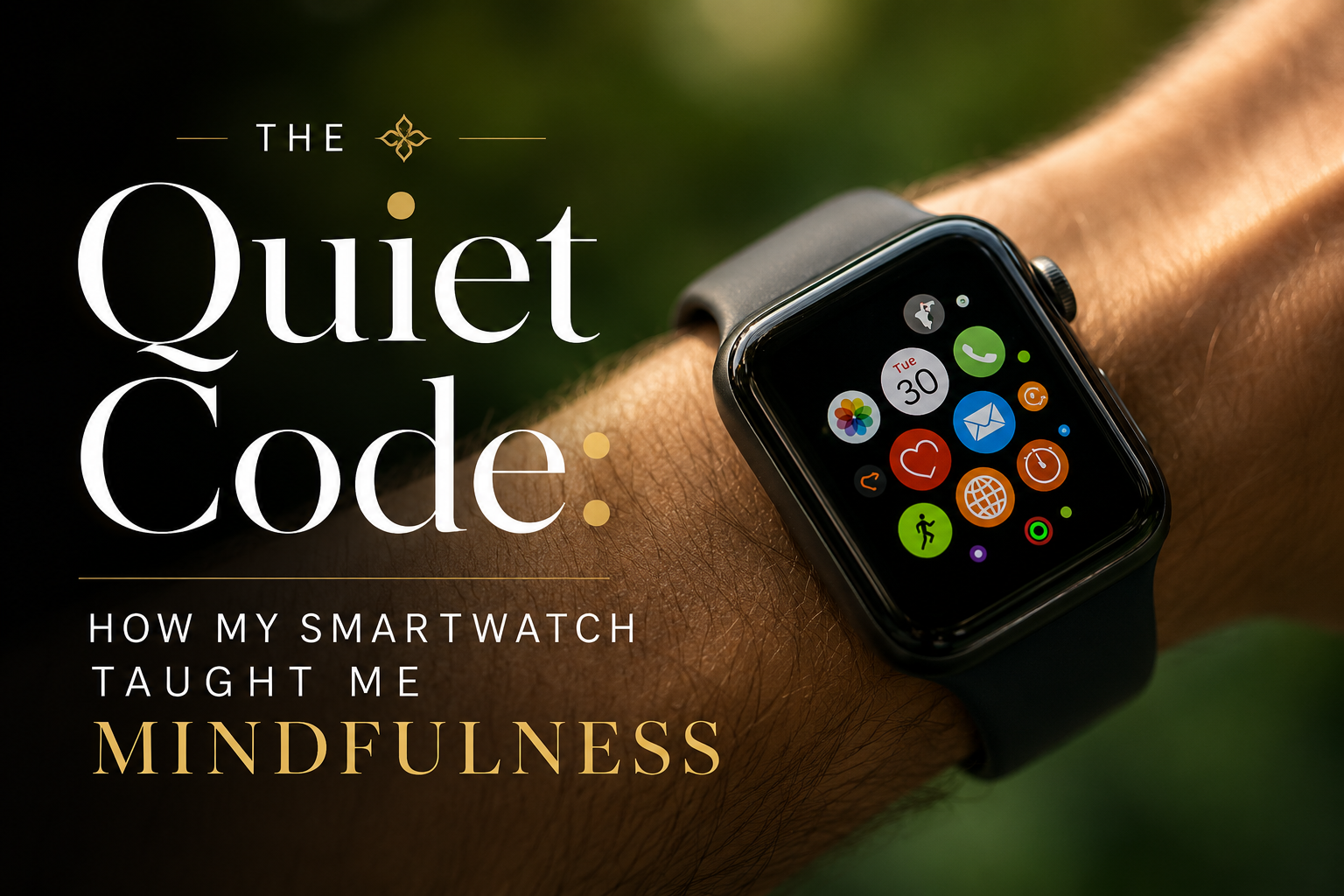
The Quiet Code: How My Smartwatch Taught Me Mindfulness in a Noisy World
The Story Begins
I did not buy my smartwatch to become more mindful. I bought it for the same reason millions of people buy wearable technology every year. I wanted efficiency, cleaner scheduling, faster notifications, easier fitness tracking, and one less reason to constantly pull out my phone. Like most people living in the modern digital world, I convinced myself that more connectivity would somehow create more control.
At first, the watch felt exactly like what I expected. It counted my steps, tracked my sleep, displayed incoming emails, and buzzed whenever another message demanded attention. It became another glowing extension of the internet attached directly to my body.
But over time, something unexpected happened. The device stopped feeling like a machine and started feeling like a mirror.
Every vibration on my wrist became more noticeable, not because of the notifications themselves, but because of how my body reacted to them. Some alerts barely registered while others created instant tension in my chest. I began noticing that my breathing changed depending on who was messaging me, what project I was working on, or how overwhelmed my mind already felt.
One evening while working late on interface concepts for PictureThisInk, I glanced down at the heart-rate graph on my watch. The spikes lined up almost perfectly with moments of frustration during debugging. Then I watched the graph slowly calm after I paused, leaned back in my chair, and took several deep breaths.
That was the first time I realized something important. The watch was not simply tracking my body. It was revealing patterns about my mind. In a world overflowing with noise, distractions, and endless stimulation, that realization felt strangely human.
The Science Behind Wearables and Mindfulness
The relationship between wearable technology and mindfulness is no longer just anecdotal. Researchers are now studying how biometric feedback can influence emotional awareness and stress reduction.
A 2025 study published in PLOS ONE found that mindfulness-based stress reduction programs supplemented with smartwatch physiological feedback improved mindfulness and reduced stress levels in participants. Researchers observed measurable improvements when wearable devices helped users become more aware of physiological signals connected to emotional regulation.
What makes this important is not the technology alone, but the behavioral shift it encourages. For years, most wearable technology focused heavily on optimization. Users were encouraged to chase higher scores, more activity, longer streaks, and increased productivity. Researchers are increasingly discovering that awareness-based interaction may produce healthier long-term outcomes than obsessive performance tracking.
This distinction matters more than people realize. A person constantly checking calories, sleep scores, productivity streaks, and biometric data can easily become trapped in another cycle of anxiety disguised as self-improvement. But when wearable data is approached with curiosity instead of pressure, it becomes something else entirely. It becomes feedback. It becomes perspective.
The smartwatch becomes less like a scoreboard and more like a conversation between the nervous system and conscious attention.
When Technology Became a Reflection Instead of a Distraction
For decades, consumer technology was designed around interruption. Notifications, autoplay systems, alerts, advertisements, and recommendation algorithms all competed aggressively for human attention. The louder the platform became, the more engagement it generated.
But wearable technology introduced a subtle shift. Instead of forcing attention outward, it quietly redirected attention inward.
The numbers on my smartwatch were not judging me. They were reflecting me. They showed how stress changed my heart rate, how poor sleep affected focus, and how moments of calm created measurable physical differences inside my body.
For the first time, technology was not asking me to consume more. It was asking me to notice more.
This emerging category of awareness-centered design is becoming one of the most important conversations in modern digital wellness.
The Rise of Calm Technology
There is a phrase quietly reshaping the future of design in 2026: calm technology.
The term was originally introduced in 1995 by researchers Mark Weiser and John Seely Brown at Xerox PARC. Their idea was simple but revolutionary. Technology should “inform but not demand our focus or attention.” That philosophy feels more relevant today than ever before.
People are exhausted by endless stimulation. Notifications compete for attention every minute. Screens dominate work, entertainment, communication, and even rest. As a result, many users are beginning to prioritize devices and systems that create emotional balance instead of digital overload.
The smartest products in 2026 are no longer necessarily the loudest. They are the ones that know when to stay quiet.
This philosophy is now influencing everything from smartwatches and wellness rings to adaptive lighting systems and AI-driven interfaces. Designers are exploring systems that respond to stress levels, reduce unnecessary interruptions, and blend more naturally into human routines.
The future of innovation is becoming less about capturing attention and more about protecting it.
Living Inside the Quiet Code
A few weeks ago, my smartwatch buzzed with one of its standard reminders telling me to take a moment to breathe. Normally I would dismiss it instantly because productivity culture conditioned me to believe stopping meant falling behind.
But that evening something felt different.
Instead of ignoring the reminder, I closed my laptop and stepped outside. The sky was fading into soft orange light across the fields in Spring Hill, Tennessee. The air felt cool. The noise from the inside world disappeared almost instantly. There were no notifications, no scrolling, and no constant stream of information trying to occupy my mind.
For several minutes, I stood there doing absolutely nothing except paying attention to the moment.
Strangely, that moment felt more productive than hours of overstimulation.
When I returned to my desk afterward, the work flowed differently. My thoughts felt cleaner. The design problems that seemed frustrating earlier suddenly felt manageable. It was as if my brain had quietly rebooted itself.
That experience changed how I viewed pauses forever. Rest was not interrupting creativity. Rest was restoring it.
The Limits of Smartwatch Wellness
Despite the excitement surrounding wearable wellness technology, researchers also warn against overreliance on biometric tracking.
A 2025 study covered by The Guardian found that smartwatch stress readings often showed little correlation with users’ self-reported emotional stress. Researchers noted that physiological signals like elevated heart rate can reflect excitement, exercise, illness, or anxiety, making emotional interpretation more complicated than many consumers realize.
This distinction matters because wearable devices are consumer tools, not medical diagnoses. A smartwatch can identify patterns and physiological changes, but it cannot fully understand human emotion or context. Elevated heart rate during exercise may appear similar to stress. Excitement and anxiety can produce overlapping physical signals.
That does not make wearables useless. It simply means mindfulness still requires human interpretation.
The real value of wearable technology is not blind obedience to numbers. The value is increased awareness. The device can highlight patterns, but the individual must decide what those patterns mean within the context of their own life.
Technology can guide reflection, but it cannot replace self-awareness.
The Psychology of Constant Connectivity
One of the strangest realities of modern life is that people have never been more connected digitally while simultaneously feeling mentally overwhelmed. Smartphones blurred the line between work and rest years ago. Smartwatches pushed connectivity even closer by placing the internet directly onto the body.
At first glance, that sounds dangerous for mental health, and in some cases it absolutely can be.
But wearable technology also introduced something unexpectedly valuable: awareness of overload itself.
A smartwatch can reveal elevated stress patterns before a person consciously recognizes them. It can expose poor sleep habits, increased heart-rate variability during anxiety, or behavioral patterns linked to burnout.
For many people, the device becomes evidence that the body keeps score even when the mind ignores warning signs.
This is where mindfulness and wearable technology intersect in a powerful way. Mindfulness is not about escaping technology completely. It is about becoming conscious while using it.
The real danger is not technology itself. The danger is unconscious consumption.
A smartwatch cannot create peace on its own, but it can remind someone to pause long enough to reconnect with it.
The Quiet Revolution Happening in Digital Wellness
Digital wellness used to feel like a niche conversation. Now it is becoming a survival conversation.
The average person absorbs thousands of notifications, advertisements, content fragments, and algorithmic stimuli every single day. Attention has become one of the most valuable commodities in the digital economy, and nearly every major platform competes aggressively for it.
As a result, people are becoming mentally exhausted in ways previous generations never experienced.
This exhaustion explains why meditation apps, focus modes, sleep technology, ambient soundscapes, wearable recovery systems, and mindful interface design are growing rapidly. People are no longer just looking for entertainment from technology. They are looking for protection from overload.
The irony is fascinating. The same industry that helped create digital overstimulation is now racing to solve it.
Perhaps that is exactly where the future is heading, not toward abandoning technology entirely, but toward redesigning humanity’s relationship with it.
The Lesson Hidden Beneath the Notifications
When I first bought my smartwatch, I thought I was purchasing a better clock. What I actually received was a better compass.
Not a compass pointing north.
A compass pointing inward.
Every subtle buzz became a reminder to pay attention, not only to deadlines and messages, but to breathing, posture, tension, focus, energy, and presence. The device slowly taught me something most modern systems ignore completely.
Awareness matters more than speed.
The quiet code is not hidden inside the software. It is hidden inside the moments we usually rush past. It exists in the breath between notifications, the silence before reacting, and the decision to pause before drowning in digital noise again.
Technology may never stop evolving, but perhaps the real evolution is learning how to remain human while using it.
Final Reflection
The future of wellness will not be built only in hospitals, gyms, or meditation retreats. It will also be built into the devices people wear every day.
The next generation of technology is not just learning how to track human behavior. It is learning how to respond to human emotion. Devices are becoming more adaptive, more ambient, and more aware of the psychological effects they create.
That shift could redefine the relationship between humanity and technology forever.
Because the most advanced technology of the future may not be the loudest, fastest, or most addictive.
It may be the technology that knows when to become quiet.
Sometimes the smallest vibration on your wrist can become the reminder that brings you back to yourself.