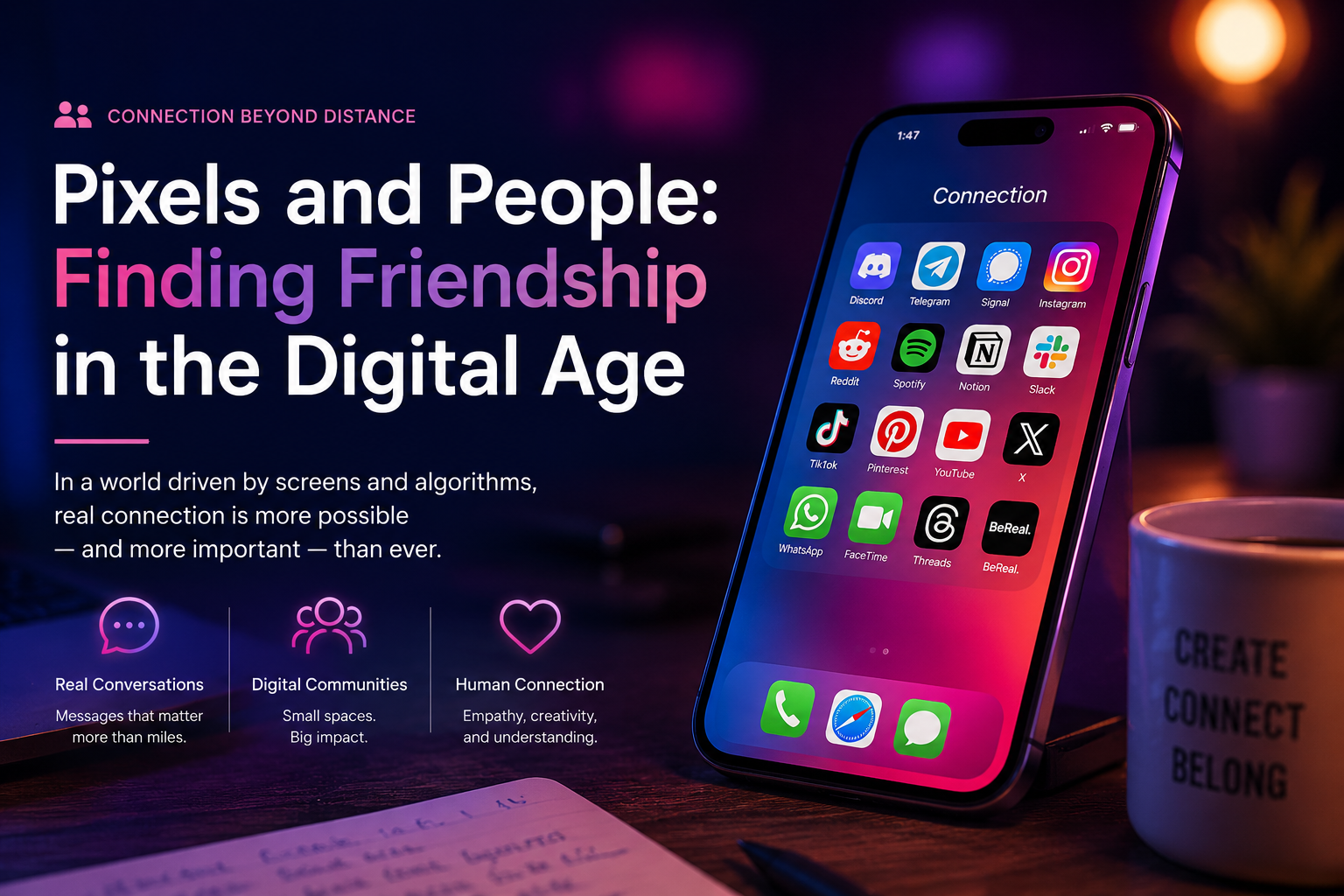
Pixels and People: Finding Real Connection in a Digital World
Meta Title: Pixels and People: Finding Real Connection in a Digital World
Meta Description: In an era shaped by screens, algorithms, and constant connectivity, digital friendships are becoming more meaningful, creative, and emotionally real than ever before.
Tags: digital culture, online friendship, internet communities, technology and society, digital wellness, online creativity, internet culture, emotional technology, PictureThisInk, modern connection
The Story Begins
It was 1:47 a.m., and the glow from my monitor was the only light left in the room.
I had been staring at the same line of code for nearly an hour, exhausted enough to quit but stubborn enough to keep trying. My coffee was cold, my eyes burned from staring at the screen, and every solution I tested somehow created an entirely different problem.
Out of frustration, I opened a small Discord server I had joined months earlier. It was not a massive community filled with thousands of strangers chasing attention. It was smaller, quieter, and strangely personal. Designers, developers, artists, writers, and creators from different parts of the world gathered there almost every night to share projects, ideas, failures, and victories while most people slept.
We called it “The Ink Collective.”
I typed a short message explaining the issue I could not solve.
Thirty seconds later, someone replied.
“Try reversing the input listener.”
Another message appeared almost immediately after.
“You’ve got this. Don’t quit tonight.”
That small sentence hit harder than caffeine ever could.
Because in that moment, I realized something I had never fully understood before.
Connection does not require proximity.
It only requires presence.
The Internet Is Quietly Redefining Friendship
For years, people treated online friendships like temporary distractions rather than meaningful relationships. Internet culture often carried the assumption that digital interactions were somehow less authentic than connections formed in person. Online friendships were dismissed as shallow, artificial, or emotionally incomplete.
But the internet has changed.
And so have we.
In 2026, digital spaces are becoming more emotionally intelligent, more community-driven, and far more personal than the algorithm-heavy social media environments that dominated the previous decade. People are slowly moving away from massive public platforms built entirely around performance and attention, and they are rediscovering smaller communities built around trust, creativity, collaboration, and belonging.
Friendship itself is evolving alongside technology.
Today, some of the strongest emotional connections begin through shared interests, creative projects, gaming communities, design groups, coding servers, late-night conversations, and online spaces where people feel understood instead of judged.
The modern internet is no longer just a place to consume content.
For many people, it has become a place to feel seen.
The Shift from Attention to Belonging
The old internet rewarded noise.
Everything revolved around followers, engagement, virality, visibility, and constant performance. People were encouraged to build audiences instead of relationships, and social platforms trained users to measure value through numbers rather than emotional depth.
Over time, that culture became exhausting.
People started realizing they could spend hours scrolling through endless content while still feeling disconnected from everyone around them. Platforms built for maximum engagement often created minimum intimacy.
Something began shifting because of that exhaustion.
Users started searching for spaces that felt smaller, safer, calmer, and more emotionally real. Private communities, invite-only groups, niche forums, collaborative servers, and creativity-driven platforms began growing rapidly because they offered something larger platforms slowly lost.
Presence.
People no longer wanted to perform for crowds every second of the day.
They wanted spaces where they could simply exist honestly.
That shift is changing digital culture in ways that feel surprisingly human.
My Digital Tribe
When I first started building PictureThisInk, I expected creativity.
I expected people to share artwork, designs, ideas, photography, concepts, and conversations about technology and culture. I imagined a space where creators could express themselves visually and connect through imagination.
What I did not expect was companionship.
People were not simply uploading content.
They were uploading pieces of themselves.
One creator shared artwork inspired by grief after losing someone close to them. Another posted their first freelance design project after months of doubting their own abilities. A developer from another country stayed awake helping strangers debug projects they were ready to abandon completely.
Someone once uploaded a sunrise photo titled “Still Here.”
That title stayed in my mind for days.
Because beneath all the technology, what people were really sharing was emotion.
Every message felt less like ordinary social media interaction and more like quiet recognition between people trying to navigate life at the same time.
It felt human.
Why Digital Friendship Feels More Real Than Ever
One of the biggest misconceptions about online relationships is the belief that screens automatically weaken emotional connection.
But emotional connection has never depended entirely on physical distance.
It depends on timing, honesty, empathy, vulnerability, and emotional presence.
Sometimes a late-night message from someone hundreds of miles away reaches deeper than a conversation happening directly beside you. Sometimes encouragement from an online community arrives at the exact moment someone feels invisible offline.
Technology did not erase human emotion.
It simply created new places for emotion to exist.
That is why digital friendships can feel surprisingly powerful. People often open up faster online because digital spaces sometimes feel safer than physical environments where fear of judgment is stronger.
In many online communities, people are no longer trying to appear perfect.
They are trying to appear understood.
There is a massive difference between those two things.
Creativity Is Bringing People Together Again
One of the most beautiful changes happening online right now is the rise of collaborative creativity.
People are no longer satisfied with simply consuming content all day.
They want to build things together.
Artists collaborate across continents. Designers help strangers improve portfolios. Developers stay awake fixing projects for people they have never met in person. Writers form communities around shared emotions, experiences, and ideas. Small creative groups emerge around healing, ambition, storytelling, and curiosity rather than status or popularity.
That collaborative energy is changing the emotional atmosphere of the internet.
For years, digital culture felt increasingly competitive.
Now, in many corners of the online world, it feels cooperative again.
That matters because creativity naturally creates connection.
People bond faster when they build something together. Shared projects create trust, and trust slowly turns strangers into collaborators, collaborators into friends, and friendships into support systems capable of lasting far beyond screens.
It is strange how something that begins as pixels can slowly become purpose.
Technology Is Becoming More Emotional
Modern technology is often criticized for making people feel isolated, distracted, disconnected, or emotionally numb.
Sometimes those criticisms are fair.
But technology itself is not emotionally empty.
Technology reflects the intention behind the spaces people create.
A toxic platform creates toxic experiences. A thoughtful community creates meaningful ones. An environment built around outrage produces anxiety, while an environment built around creativity and empathy produces connection.
That distinction matters more than most people realize.
The internet feels cold when everything revolves around performance and attention. But when people intentionally create spaces centered around collaboration, support, imagination, honesty, and emotional safety, technology begins feeling less mechanical and more human again.
That is why smaller digital communities continue growing stronger.
They remind people that the internet still has the ability to connect rather than divide.
The Future of Human Connection Online
The future of internet culture will likely revolve less around massive audiences and more around meaningful interaction.
People are becoming more intentional about where they spend emotional energy online because attention itself has become one of the most valuable resources in modern life. Users increasingly want spaces that feel genuine instead of performative and conversations that feel personal instead of algorithmically manufactured.
In many ways, digital culture is becoming emotionally aware.
The next generation of online platforms will likely focus more heavily on:
shared creativity,
digital trust,
smaller communities,
mental wellness,
collaboration,
authentic interaction,
and emotionally intelligent experiences.
Ironically, the more advanced technology becomes, the more human people seem to want the internet to feel.
That may end up being the most important trend of all.
Closing Reflection
When people say the internet is not real life, I understand what they mean.
But I also think they are missing something important.
Some of the most encouraging conversations I have ever experienced happened through screens. Some of the most supportive people I have ever met were individuals I may never physically stand beside in the same room.
And yet their presence still mattered deeply.
Every late-night message, every shared idea, every voice note, every creative collaboration, and every small moment of encouragement carried something undeniably real behind it.
Human attention.
Human empathy.
Human connection.
In the end, friendship is not defined by geography.
It is defined by presence.
And sometimes the strongest connections begin with nothing more than pixels on a screen.