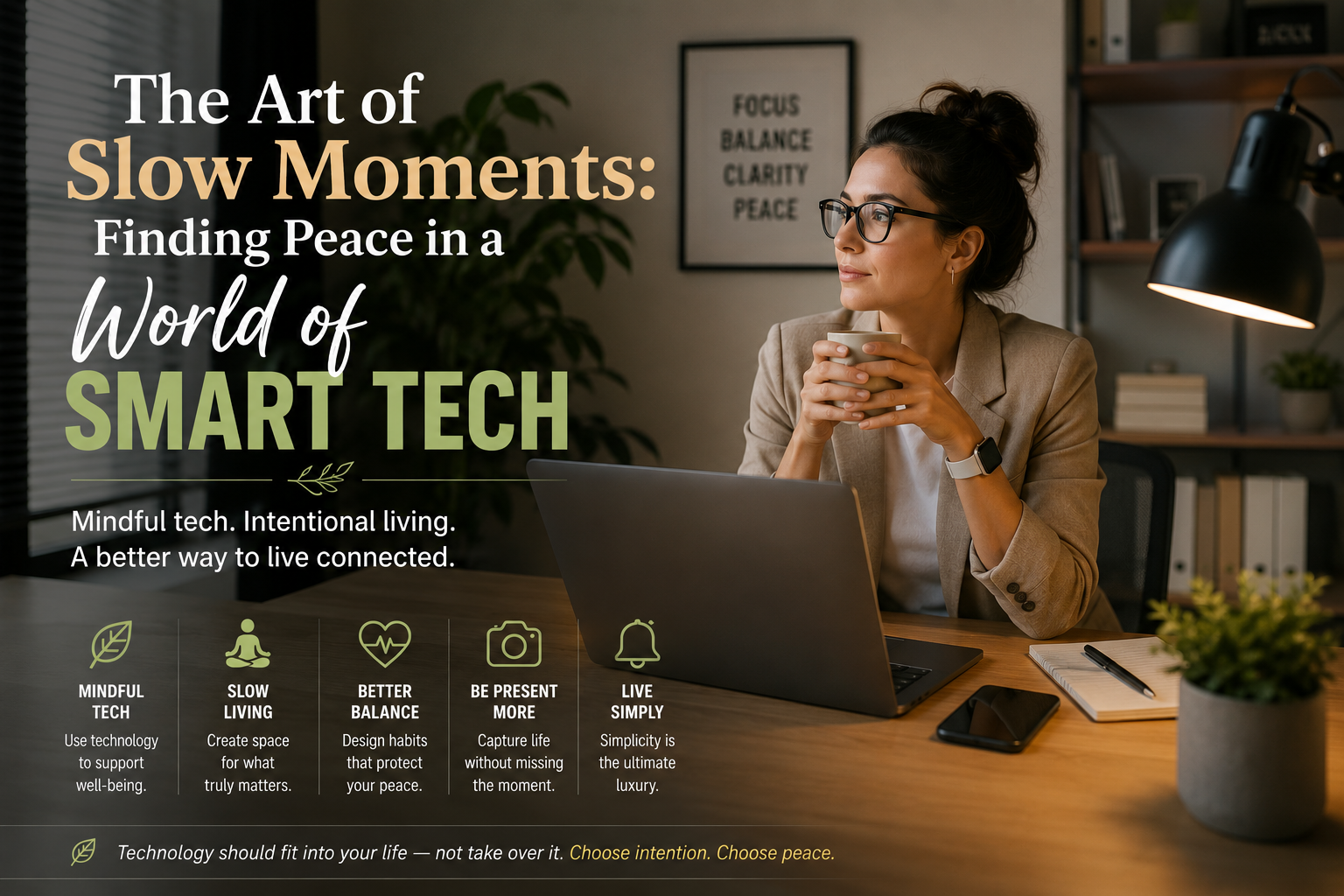
The Art of Slow Moments: Finding Peace in a World of Smart Tech
The World Became Faster Than Humans Were Ready For
Most mornings now begin the same way.
A screen lights up before sunlight reaches the room. Notifications arrive before thoughts fully form. Smartwatches vibrate with reminders, messages, calendar alerts, health metrics, weather updates, and endless digital signals demanding attention before the day has even properly started.
Technology has become deeply woven into modern life.
Phones rest beside pillows. Watches monitor sleep cycles. Wireless earbuds follow people into grocery stores, gyms, sidewalks, airports, and restaurants. Every moment of silence is now vulnerable to interruption.
The modern world no longer waits for attention.
It competes for it constantly.
That endless stream of information has created a strange contradiction in modern culture. Technology was originally designed to make life more efficient, yet many people now feel mentally exhausted by the very tools built to simplify daily living.
People are more connected than ever before, but many quietly feel overwhelmed by constant digital stimulation.
That emotional fatigue is helping create an entirely new cultural movement centered around slowing down without disconnecting completely from modern technology.
The Rise of Mindful Technology
A few years ago, wearable technology was mostly associated with fitness tracking and productivity. Smartwatches counted steps, tracked calories, and delivered notifications faster than phones could.
Today, the relationship between people and technology is evolving.
Modern consumers are becoming increasingly interested in technology that supports emotional wellness instead of simply demanding more engagement. Companies are slowly beginning to understand that the future of technology is not only about speed or power. It is also about balance.
Features once considered secondary are now becoming central to modern devices.
Breathing reminders. Sleep tracking. Focus modes. Meditation timers. Screen time reports. Digital wellness settings. Quiet notifications. Stress monitoring.
These tools reflect a growing realization that people no longer want technology controlling every moment of their lives. They want technology that adapts to human needs instead of forcing humans to adapt to endless digital noise.
Mindful technology is becoming less about escaping innovation and more about redesigning the relationship between humans and devices.
That shift is changing modern culture in ways that are becoming impossible to ignore.
Slow Living Is No Longer About Escaping Technology
For years, slow living was associated with disconnecting entirely from modern life. People imagined cabins in the woods, offline weekends, handwritten journals, and lifestyles completely separated from technology.
But modern slow living looks very different.
In 2026, balance matters more than escape.
People are learning that peace does not always require abandoning technology completely. Instead, many are discovering the importance of using technology intentionally rather than automatically.
That difference changes everything.
A smartwatch can become a tool for mindfulness instead of stress. A phone can become a creative instrument instead of an endless distraction. Smart home devices can simplify routines instead of increasing digital overload.
The problem is not always technology itself.
The problem is unconscious usage.
Modern life often pushes people toward constant reaction. Slow living encourages intentional response instead. That subtle difference is reshaping how many people approach work, creativity, relationships, wellness, and personal time.
Technology is slowly becoming part of a larger conversation about emotional sustainability.
People want devices that fit naturally into life rather than dominate it.
The New Luxury Is Peace
Modern culture spent years celebrating speed.
Faster phones. Faster internet. Faster communication. Faster delivery. Faster content. Faster trends.
Now people are beginning to crave something entirely different.
Stillness.
Quiet mornings have become luxurious. Uninterrupted conversations feel rare. Walks without notifications feel strangely healing. Even moments without digital stimulation now feel emotionally valuable in ways many people never expected.
That cultural shift is influencing everything from fashion to interior design to technology development itself.
Minimalist digital interfaces are becoming more popular. Wellness-focused technology continues growing rapidly. Consumers are increasingly drawn toward products that reduce stress rather than amplify it.
Even luxury branding is changing.
Many modern lifestyle campaigns no longer focus entirely on productivity or status. Instead, they focus on calmness, focus, clarity, balance, rest, and emotional well-being.
The definition of success itself appears to be evolving.
People are no longer only chasing efficiency.
Many are chasing peace.
Designing a More Intentional Digital Life
One of the most important realizations people are beginning to have is that digital wellness is not created automatically.
It is designed intentionally.
Healthy technology habits rarely happen by accident in a world built around constant engagement. People now have to actively create boundaries protecting their attention, energy, and emotional focus.
That may mean silencing unnecessary notifications. It may mean leaving devices outside the bedroom. It may mean creating no-phone spaces during meals, conversations, creative work, or quiet evenings.
Small digital habits now have enormous emotional impact.
A simple walk without a phone can feel restorative. Turning off notifications for an hour can reduce mental tension dramatically. Leaving a smartwatch behind during dinner can create a stronger sense of presence than many people realize.
These small choices may appear insignificant individually, but collectively they reshape the emotional atmosphere of daily life.
That is why intentional technology use is becoming one of the defining wellness conversations of modern culture.
The Beauty of Human Moments
Technology often performs best when it quietly supports life instead of interrupting it.
The most meaningful moments people remember are rarely the moments spent staring at screens. They are the conversations, experiences, environments, emotions, and connections happening around them.
A sunset viewed without reaching for a phone camera. A conversation uninterrupted by notifications. A peaceful morning walk where thoughts are allowed to settle naturally.
These moments are becoming emotionally powerful precisely because they feel increasingly rare.
Modern life constantly encourages performance and visibility. Slow moments encourage awareness instead.
That awareness matters.
Because beneath every screen, every device, and every algorithm is still a human being searching for calm, meaning, connection, and emotional clarity in an increasingly loud world.
And perhaps that is the future many people truly want.
Not less technology.
Better balance.
Closing Reflection
The art of slow moments is not about rejecting modern life.
It is about protecting the parts of humanity that constant stimulation often tries to erase.
Technology will continue evolving. Devices will become smarter. Artificial intelligence will become more integrated into everyday routines. Digital experiences will continue expanding into nearly every corner of life.
But even in a world shaped by smart technology, people will still crave quiet mornings, uninterrupted conversations, peaceful environments, meaningful rituals, and moments that feel emotionally real.
The future of wellness may not belong to people who disconnect completely from technology.
It may belong to people who learn how to use technology without allowing it to consume their attention entirely.
Because the most advanced future imaginable will still need something profoundly human at its center.
Peace.