The Digital Health Revolution: How Technology Could Transform Medicine in 2026
By PictureThisInk Editorial Team
For years, conversations around technology focused on faster phones, smarter software, and the race to build more powerful artificial intelligence. But as 2025 comes to a close, the center of innovation is beginning to shift toward something far more personal: healthcare.
The lines separating medicine, artificial intelligence, biotechnology, robotics, and data science are rapidly disappearing. What once felt like futuristic concepts are now moving into hospitals, clinics, research labs, and even people’s homes. The healthcare industry is no longer simply adopting technology — it is becoming technology.
As the world moves toward 2026, experts believe the next era of medicine may be defined not only by doctors and pharmaceuticals, but by predictive algorithms, intelligent machines, wearable sensors, and systems capable of detecting illness before symptoms fully appear.
The future of healthcare may not begin inside the emergency room. It may begin through data.
AI Is Becoming Medicine’s New Assistant
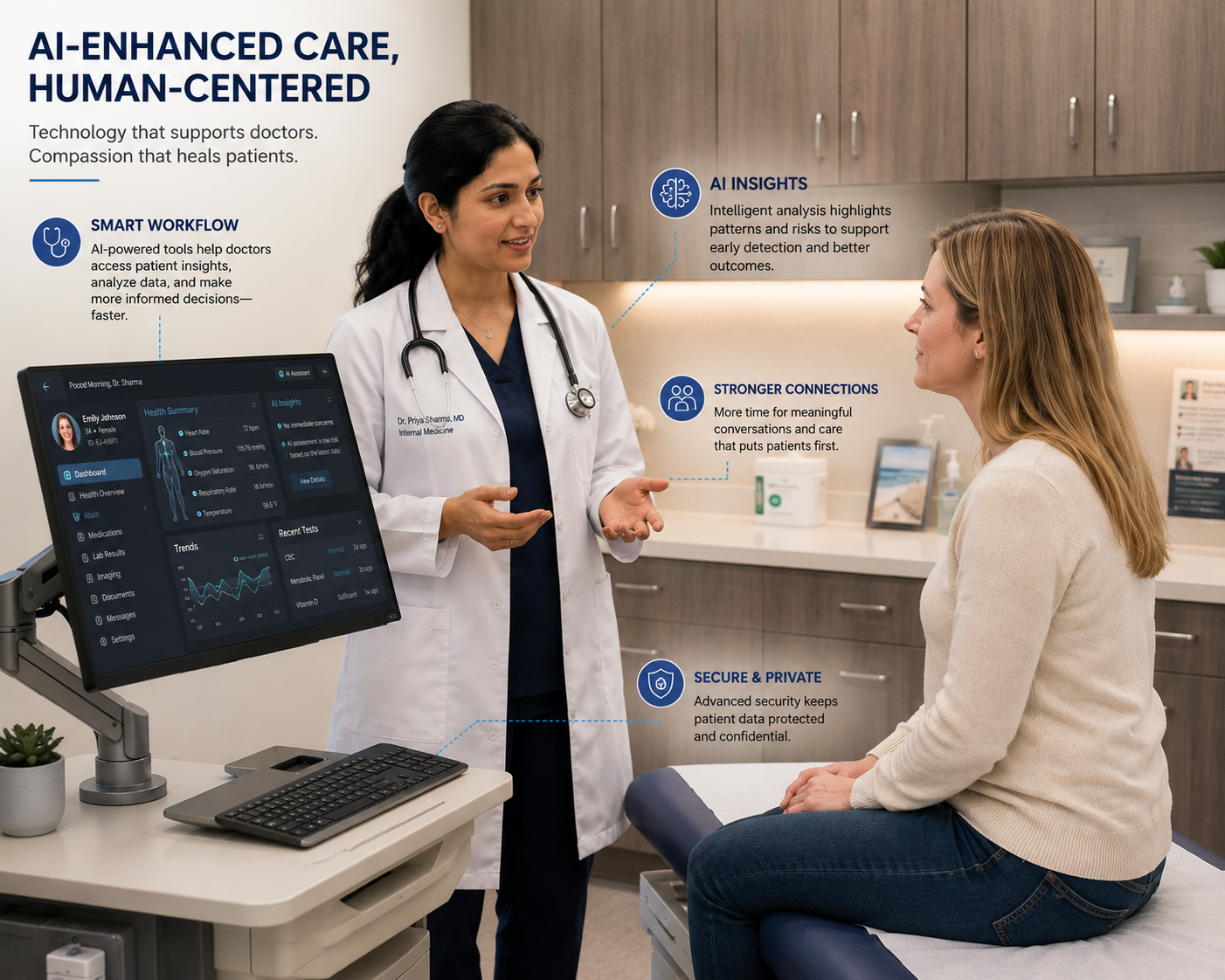
Artificial intelligence is quickly becoming one of the most powerful tools in modern healthcare. In 2025, AI systems are already helping researchers analyze medical images, identify patterns in patient data, and accelerate scientific discovery at speeds impossible for humans alone.
According to researchers at MIT Technology Review and Stanford Bioengineering, AI models are beginning to assist doctors in detecting diseases such as lung cancer, Alzheimer’s disease, and cardiovascular conditions earlier than traditional methods alone.
The reason is simple. AI systems can process enormous amounts of information in seconds. A radiologist may review hundreds of scans daily, while an AI-assisted imaging system can compare millions of data points across thousands of previous cases almost instantly.
This does not mean doctors are being replaced. Instead, technology is becoming an extension of medical expertise.
As 2026 approaches, hospitals are expected to increase investments in AI-assisted diagnostics, predictive healthcare systems, and automated patient monitoring. Healthcare leaders believe these tools could reduce delays in diagnosis, improve treatment accuracy, and lower operational strain on medical staff already facing burnout worldwide.
The next generation of healthcare may rely heavily on collaboration between physicians and intelligent systems working side by side.
Wearable Technology Is Moving Beyond Fitness
Only a few years ago, wearable technology was largely associated with counting steps and tracking workouts. Today, devices such as smartwatches and biometric sensors are evolving into real health-monitoring tools.
Companies across the technology and healthcare sectors are developing wearables capable of monitoring heart rhythms, oxygen levels, stress patterns, sleep quality, blood pressure trends, and early warning signs of medical complications.
Researchers believe wearable technology could become one of the most important preventative healthcare tools entering 2026.
Instead of waiting for symptoms to become severe, patients may increasingly receive alerts before a condition escalates. Doctors may eventually use real-time patient monitoring to identify abnormalities days or weeks earlier than traditional appointments would allow.
For individuals living in rural areas or those with limited access to healthcare facilities, wearable monitoring systems may also improve access to long-term care without requiring constant hospital visits.
The idea of healthcare becoming continuous instead of occasional is beginning to reshape how experts think about medicine itself.
Personalized Medicine Could Change Treatment Forever
For decades, healthcare largely relied on generalized treatment methods. Patients with similar symptoms often received similar medications and procedures regardless of genetic differences.
That approach may begin changing rapidly over the next several years.
Advances in biotechnology and artificial intelligence are helping researchers move toward personalized medicine — a healthcare model that tailors treatment plans to the individual patient rather than the broader population.
By analyzing genetic information, environmental factors, lifestyle habits, and medical history, researchers hope to develop treatments designed specifically for each person’s biological profile.
Some experts believe this shift could dramatically improve treatment success rates while reducing harmful side effects associated with generalized medications.
Cancer research is already seeing early examples of this transformation. AI-assisted systems are helping scientists identify unique tumor behaviors and explore therapies based on the specific genetic makeup of a patient’s disease.
As computing power continues improving into 2026, personalized healthcare may become one of the most important developments in modern medicine.
Robotics Are Redefining Surgery
Robotic-assisted surgery has existed for years, but advancements in precision technology and machine learning are pushing the field further.
Modern robotic systems already assist surgeons during delicate procedures requiring extremely steady movements and microscopic accuracy. These systems can reduce surgical invasiveness, improve precision, and shorten patient recovery times.
As healthcare technology evolves, experts believe surgical robotics may become more intelligent, adaptive, and accessible to hospitals around the world.
Future systems may integrate AI-driven imaging, predictive analytics, and real-time surgical assistance capable of helping physicians make more informed decisions during procedures.
Rather than replacing surgeons, robotics may become one of the most valuable support tools in operating rooms heading into 2026.
The combination of human expertise and machine precision could significantly reshape surgical care over the next decade.
Smart Hospitals Are Beginning to Emerge
Hospitals themselves are also evolving through technology integration.
Healthcare systems are increasingly investing in automated scheduling, digital patient records, AI-assisted resource management, and predictive analytics capable of forecasting patient needs before crises occur.
Some medical centers are experimenting with intelligent systems designed to monitor patient flow, reduce wait times, optimize staffing levels, and manage supply chains more efficiently.
In the future, experts believe hospitals may function more like interconnected technology ecosystems than traditional healthcare facilities.
Patient monitoring systems may automatically alert nurses to early complications. AI-driven software could assist emergency departments in prioritizing critical cases faster. Predictive systems may even help hospitals prepare for disease outbreaks before they intensify.
As healthcare demands continue rising globally, efficiency and data integration are becoming just as important as medical equipment itself.
Drug Discovery Is Accelerating Faster Than Ever
One of the most promising intersections of AI and medicine is pharmaceutical research.
Traditionally, developing new medications required years of expensive testing, research, and analysis. Artificial intelligence is beginning to shorten portions of that process dramatically.
AI systems can analyze molecular structures, simulate chemical interactions, and identify potential drug candidates far faster than traditional manual methods.
Companies like DeepMind and Insilico Medicine are already exploring how machine learning can accelerate drug development for diseases ranging from cancer to neurodegenerative disorders.
Researchers believe the next wave of pharmaceutical breakthroughs could emerge from AI-assisted discovery systems capable of analyzing biological data at unprecedented scale.
As 2026 approaches, healthcare innovators are preparing for a future where new treatments may be developed faster, tested smarter, and delivered more efficiently than ever before.
The Challenges Behind the Innovation
Despite the excitement surrounding healthcare technology, major concerns remain.
Medical privacy, cybersecurity, ethical AI usage, and data protection are becoming increasingly important as healthcare systems rely more heavily on digital infrastructure.
Healthcare organizations now face the challenge of protecting massive amounts of sensitive patient information while integrating advanced AI systems into everyday operations.
Questions surrounding algorithm bias, medical accountability, and automated decision-making also continue generating debate among researchers and policymakers.
Technology may improve healthcare dramatically, but experts warn that trust, ethics, and human oversight must remain central to medicine’s future.
The healthcare industry’s next phase will likely depend not only on technological advancement, but on how responsibly these systems are developed and implemented.
Looking Toward 2026
As 2025 transitions into 2026, the future of medicine appears increasingly connected to the future of technology itself.
Artificial intelligence, wearable devices, robotics, biotechnology, and predictive healthcare systems are no longer operating in separate worlds. They are converging into a new medical ecosystem built around data, personalization, and continuous care.
The healthcare industry is entering a period where technology may help doctors work faster, patients live healthier, and researchers solve problems once thought impossible.
While many challenges still remain, one thing is becoming clear: the next revolution in healthcare may not come from a single breakthrough alone.
It may come from the convergence of every technology advancing at once.