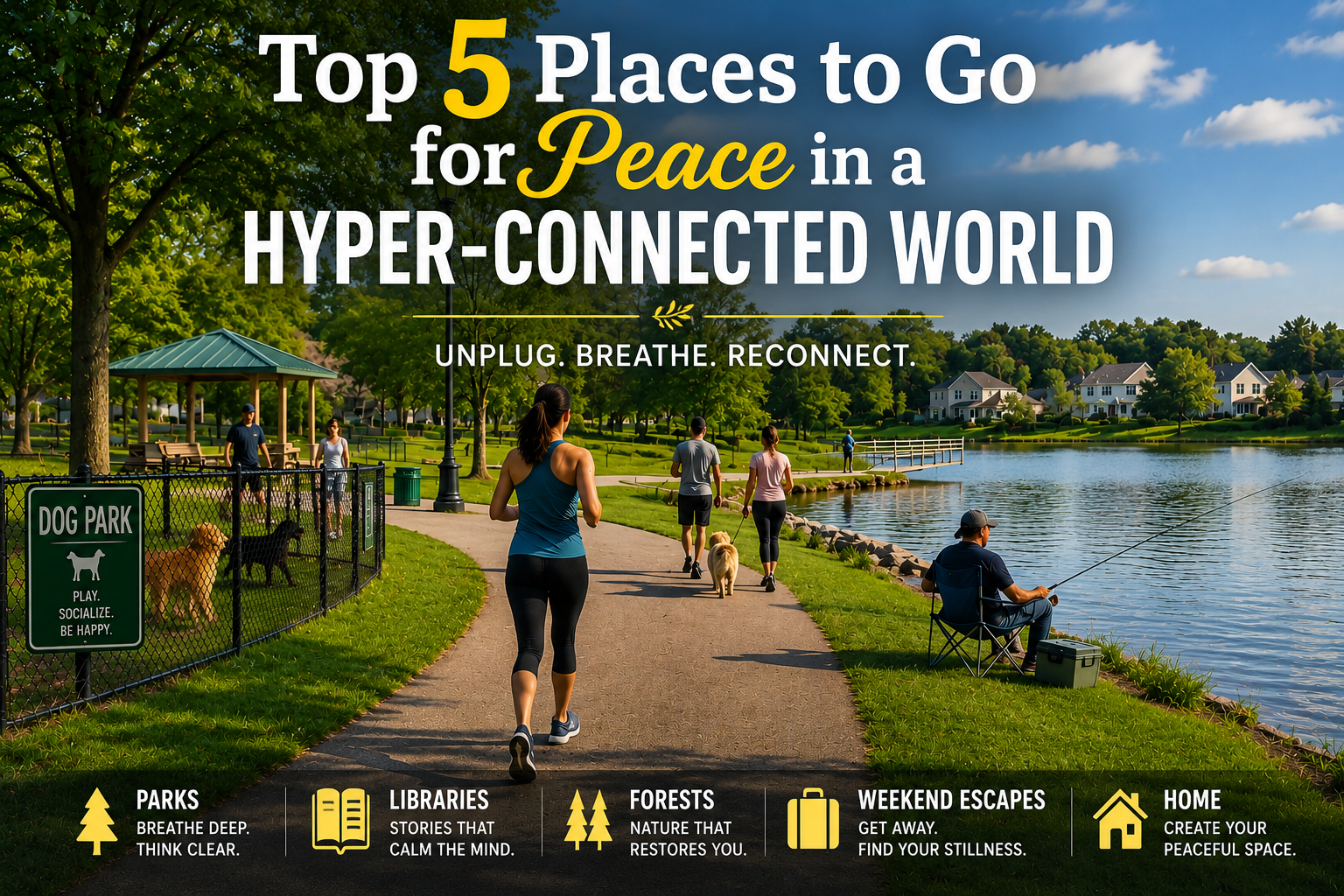
Top 5 Places to Go for Peace in a Hyper-Connected World
The Story Begins
Silence used to feel ordinary. Today, it feels expensive.
Modern life moves at a speed the human mind was never designed to sustain. Notifications arrive constantly, conversations never fully end, and screens follow people into nearly every moment of their day. The internet no longer waits patiently for attention. It competes for it every second.
A few months ago, my phone informed me that I had picked it up nearly 150 times in a single day. That number stayed in my mind because it felt less like a statistic and more like proof of how deeply modern life had wired itself into my habits. Studies now show that many people check their phones between 144 and 205 times per day, which means distraction has quietly become the default rhythm of everyday life.
That realization forced me to ask an uncomfortable question.
When was the last time I experienced true quiet without immediately reaching for a screen to interrupt it?
So I decided to search for places where peace still felt untouched. Not simply places that looked calm in photographs, but environments where technology stopped feeling important and human presence started feeling real again.
The Park That Forgot the Internet
Every city has a place where the signal weakens the moment you step far enough away from the noise. Sometimes it is a small public park hidden between neighborhoods. Sometimes it is a quiet trail wrapped around trees older than the streets surrounding them.
The first thing you notice in those places is not silence.
It is relief.
No buzzing phones. No endless scrolling. No pressure to respond immediately to messages that can easily wait another hour. The mind begins slowing down almost automatically because nature does not demand constant reaction.
The first time I sat in a park without headphones, I realized how rare uninterrupted sound had become. Wind moving through leaves sounded unfamiliar. Birds sounded sharper. Even the silence between sounds felt strangely restorative.
Technology trains people to fill every empty second with stimulation. Nature reminds people that empty space is not something to fear.
It is something to protect.
The Library That Still Feels Human
Libraries may be one of the last public spaces designed entirely around patience.
Long before social media platforms existed, libraries quietly connected people through stories, ideas, and curiosity without demanding attention in return. Walking into one today feels almost like stepping backward into a slower version of society.
The atmosphere changes immediately.
People speak softly. Pages turn slowly. Time itself seems less aggressive.
Some modern libraries now host digital detox periods designed to encourage deeper reading and uninterrupted focus. During those hours, people are encouraged to disconnect from devices and spend time engaging with physical books, quiet reflection, or uninterrupted study.
That experience feels surprisingly emotional because most people no longer realize how mentally exhausting constant digital stimulation has become until they finally step away from it.
Inside a quiet library, the brain stops reacting and starts absorbing again.
There is something deeply human about that shift.
The Forest That Resets the Mind
Nature does not send reminders.
It gives them.
Walking beneath a canopy of trees changes the nervous system in ways difficult to explain through words alone. The world begins moving differently in forests because natural environments operate on rhythms older than deadlines, notifications, and algorithms.
Researchers studying environmental psychology continue finding strong connections between time spent outdoors and improvements in stress, focus, emotional regulation, and mental clarity. A University of Michigan Environmental Psychology Lab study reported that spending twenty minutes in nature significantly reduced cortisol levels while improving concentration afterward.
But statistics cannot fully explain what forests actually feel like.
Light moving across tree bark. Wind carrying sounds through branches. The absence of digital urgency. The strange calm that appears when no one expects immediate responses from you.
The modern world constantly pushes people to react.
Nature reminds people to observe instead.
That difference matters more than many realize.
The Weekend Escape That Makes Silence Feel Valuable Again
Sometimes peace does not arrive through isolation.
Sometimes it arrives through distance.
A short drive away from crowded streets, packed schedules, and constant movement can completely shift the emotional atmosphere surrounding a person. That realization became incredibly clear during a quiet stay at Holiday Inn Club Vacations Fox River Resort in Sheridan, Illinois.
The experience felt different almost immediately.
Instead of traffic outside the window, there were trees and soft morning air moving across the river. Instead of endless noise, there was stillness. The room itself felt designed for breathing space rather than overstimulation.
The most surprising part was how quickly the mind slowed down once the phone stopped becoming the center of attention.
Coffee tasted slower. Conversations felt more present. Silence stopped feeling awkward and started feeling restorative.
What made the experience memorable was not luxury in the traditional sense.
It was simplicity.
No pressure to constantly document the moment. No overwhelming social atmosphere. No feeling that every experience needed to become content for someone else to consume online.
Just quiet.
That kind of peace feels increasingly rare in modern life, which may be why it feels so valuable now.
The Corner of Home You Decide to Reclaim
Not every form of peace requires travel.
Sometimes the most important space a person can reclaim is a small corner of their own home.
Modern interior designers increasingly speak about something called calm interiorism, which focuses on designing spaces that reduce overstimulation instead of increasing it. Soft lighting, natural textures, quieter colors, and intentional separation from digital distractions all contribute to environments that feel emotionally lighter.
But the deeper idea behind it is not design.
It is permission.
Permission to sit quietly without reaching for a phone. Permission to create moments where the internet no longer controls the emotional atmosphere of the room. Permission to let silence exist without immediately filling it with noise.
Even a single chair near a window can become a place of restoration if people allow themselves to disconnect long enough to notice what calm actually feels like.
That may be one of the most important skills modern life requires.
Closing Reflection
The modern world constantly convinces people that connection means permanent availability.
But real peace often begins when people stop responding to everything demanding their attention.
Silence is no longer ordinary.
It has become intentional.
It is crafted through boundaries, distance, nature, reflection, slower moments, and environments where people are allowed to exist without constantly performing for screens.
The truth is that peace does not always require disappearing completely from the modern world.
Sometimes it simply requires stepping far enough away from the noise to hear yourself think again.
And in a hyper-connected era where attention has become one of the most valuable resources on earth, choosing quiet may be one of the most powerful decisions a person can make.
References
How to Cut Back on Screen Time — Fortune Well, July 19 2023.
https://fortune.com/well/2023/07/19/how-to-cut-back-screen-time
Cell Phone Addiction: How Often We Check Our Phones in 2025 — Reviews.org, February 2025.
https://www.reviews.org/mobile/cell-phone-addiction
The Restorative Power of Nature and Attention Recovery — University of Michigan Environmental Psychology Lab, 2025.