Smart Glasses Are Quietly Coming Back and What That Means for How We Choose Technology
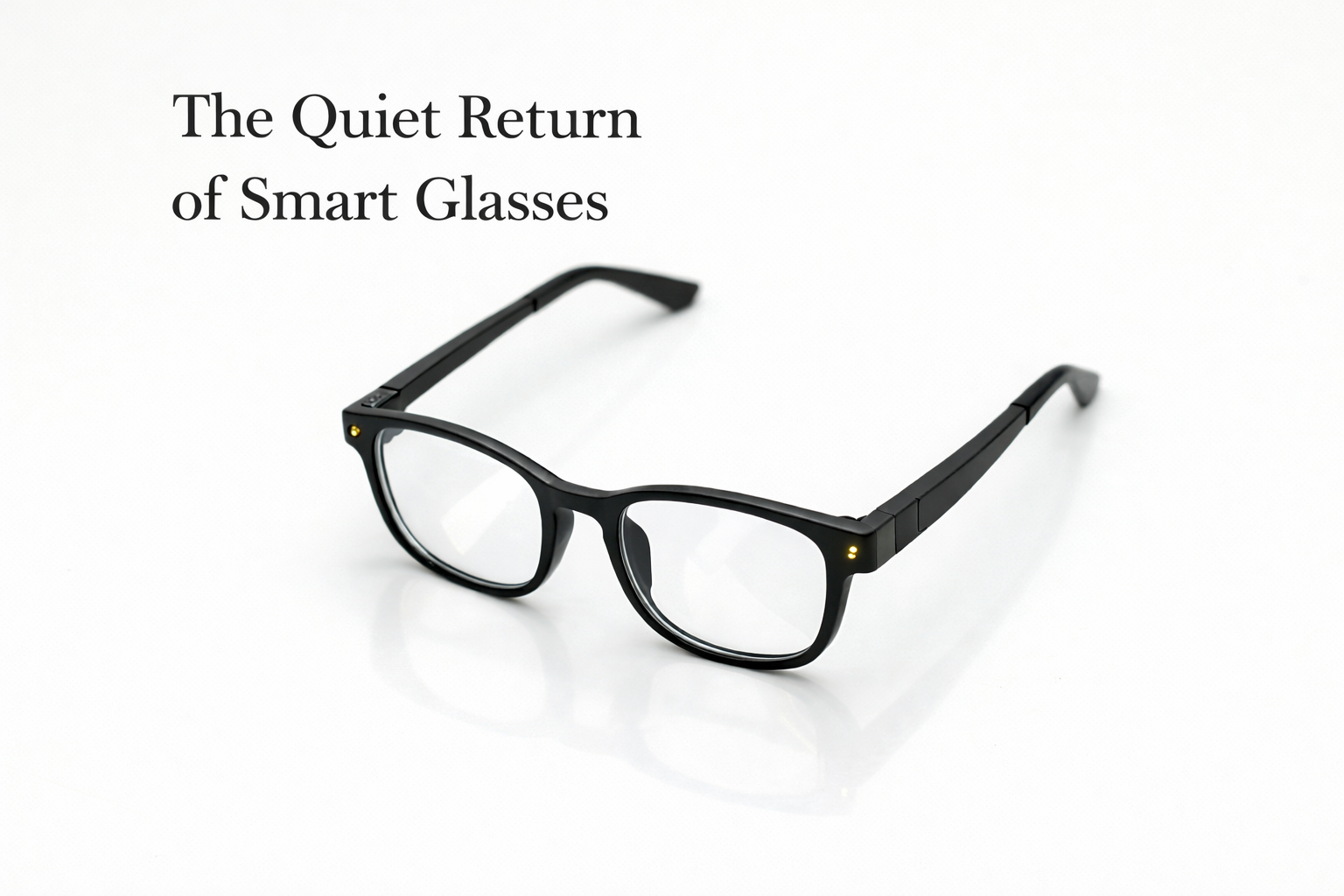
Smart glasses are coming back, but not in the way they were first introduced.
After years of false starts, public skepticism, and products that felt more experimental than useful, wearable technology is entering a different phase. Major companies are revisiting smart glasses with new priorities and fewer promises, focusing less on spectacle and more on integration.
This pattern mirrors what we’ve already seen with how many companies are using AI today, where early hype gave way to quieter, more practical adoption across industries.
This is not a relaunch driven by hype. It is a correction.
What’s Actually New Right Now
The current wave of smart glasses is not about putting screens everywhere. It is about reducing friction.
Advances in artificial intelligence, battery efficiency, voice recognition, and lightweight materials have made it possible to design wearables that assist without demanding constant attention. Instead of immersive displays and futuristic visuals, newer designs focus on voice-first interaction, contextual assistance, hands-free access to information, and comfort that supports all-day wear.
This same shift toward subtle integration is reshaping how creativity is changing with automation, where tools increasingly support human judgment instead of replacing it.
Why This Moment Matters
Smart glasses are not just another consumer gadget cycle. They reflect a broader change in how people want technology to behave.
Screens already dominate daily life. Notifications compete constantly for attention. Many users are no longer asking for more features. They are asking for fewer interruptions.
Wearable technology moves computing closer to the body, which raises expectations. Devices must be useful without being intrusive, helpful without being distracting. Smart glasses will only succeed if they respect attention.
A Broader Signal Than One Company
The return of smart glasses is not being driven by a single technology company. It is being shaped by a wider mix of brands, including performance and lifestyle eyewear makers.
When smart glasses were treated purely as tech experiments, design, comfort, and identity were secondary concerns. Today, brands with long experience in eyewear approach the category differently. They understand fit, durability, and how glasses function as part of someone’s identity, not just as a device.
This broader participation signals a move away from novelty and toward normalization. When multiple brands explore the same form factor, the question is no longer whether smart glasses belong in everyday life, but how they should fit.
That distinction reflects the same principle behind writing your own perspective instead of repeating familiar templates. Interpretation, not novelty, is what creates value.
How to Choose Smart Glasses That Actually Make Sense
Choosing wearable technology is less about specifications and more about alignment with your daily life.
Before buying smart glasses, it helps to think clearly about a few practical questions.
What problem are you trying to solve
Some smart glasses focus on navigation, others on communication, translation, or productivity. If a device does not remove a specific inconvenience, it will feel unnecessary very quickly.
Wearables work best when they solve one problem well.
How present do you want the technology to feel
Some users want visible displays and frequent interaction. Others want technology that stays quiet until needed. There is no universal preference, only personal tolerance.
The best choice is the one that fits how you already move through your day.
How often do you want to interact with it
Many people overestimate how often they want to engage with wearable tech. Frequent interaction favors richer interfaces. Occasional use favors voice and minimal design.
Honest expectations prevent regret.
How comfortable are you with data collection
Smart glasses rely on sensors. Understanding what data is collected, how it is processed, and where it lives matters more with wearables than with phones.
Trust is part of usability.
The PictureThisInk Perspective
Smart glasses are not about replacing smartphones. They are about removing small points of friction from everyday life.
The most successful wearable technology will not try to impress users. It will try to disappear until it is needed. That requires restraint, thoughtful design, and respect for attention.
At PictureThisInk, we see the return of smart glasses as part of a broader shift toward tools that amplify human judgment in the age of AI, rather than compete with it.
The question is no longer what technology can do. It is what it should do quietly and well.