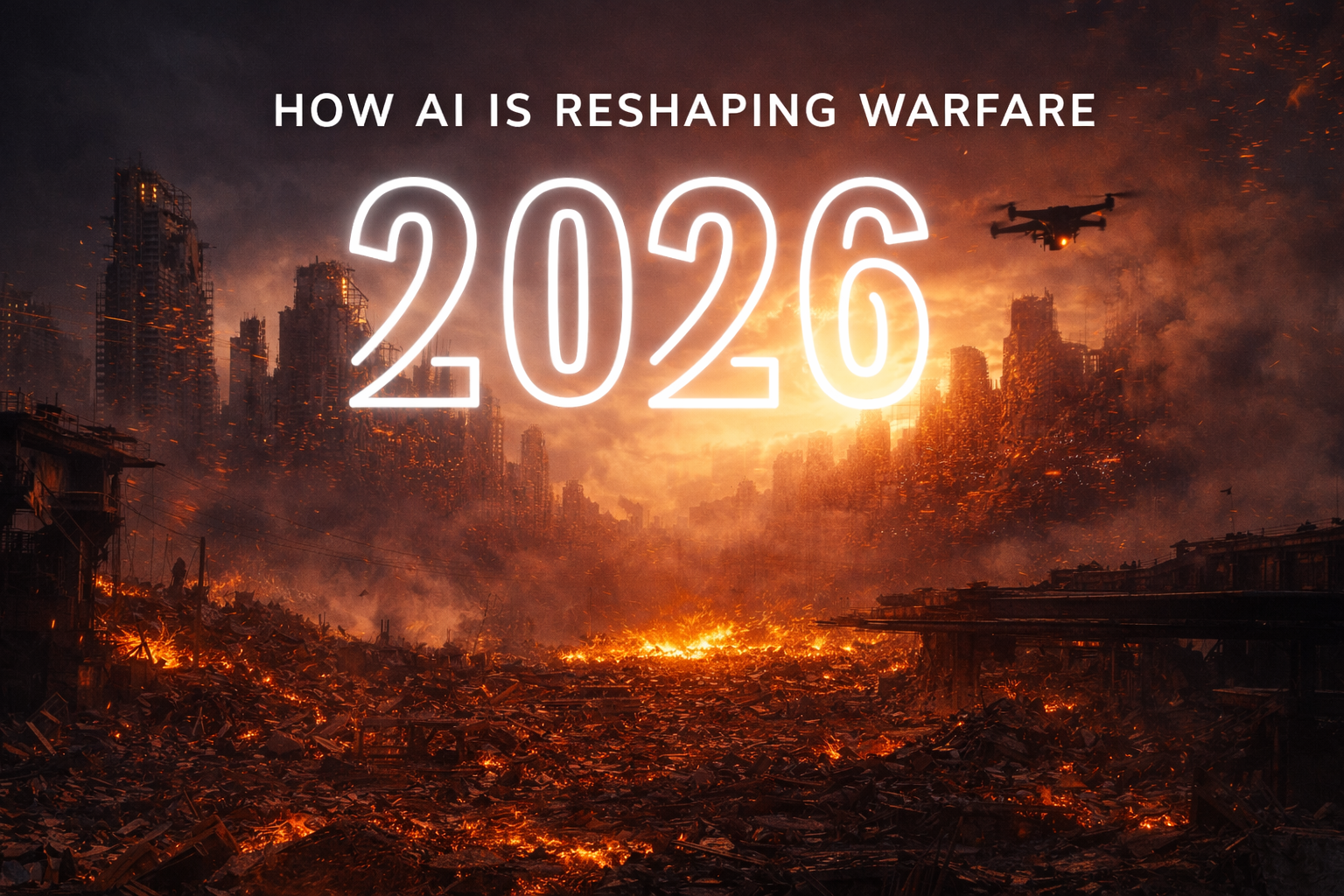
How AI Is Reshaping Warfare in 2026
The Nature of War Is Changing
War has always evolved with technology.
From gunpowder to nuclear weapons, each shift redefined power. What is happening now is different. Artificial intelligence is not just introducing new tools. It is changing how decisions are made, how actions are executed, and how quickly events unfold.
The transformation is no longer physical alone. It is systemic.
From Soldiers to Systems
Modern conflict is no longer centered on human reaction.
It is increasingly driven by systems capable of processing massive amounts of data, identifying patterns instantly, and executing decisions in real time. These systems do not rely on fatigue, emotion, or delay.
The human role is not disappearing, but it is shifting.
Strategy remains human. Execution is becoming automated.
Autonomous Systems Are Scaling Conflict
Artificial intelligence is enabling a new level of operational scale.
AI-powered drones and autonomous platforms can navigate complex environments, identify objects using computer vision, and coordinate with other systems without constant oversight. These systems can adapt mid-operation, responding to changing conditions faster than traditional command structures allow.
What once required large coordinated units can now be carried out by smaller teams supported by intelligent systems.
Scale is no longer limited by manpower. It is defined by capability.
Speed Is Becoming the Deciding Factor
In modern warfare, timing has always mattered.
Artificial intelligence compresses the time between detection, decision, and action. Processes that once required hours can now occur in seconds.
This shift changes the balance of power.
The advantage no longer belongs solely to the strongest force, but to the one that can operate faster, process more information, and act with precision under compressed timelines.
Intelligence Has Become Predictive
Surveillance is no longer just about observation.
AI systems can analyze satellite imagery, monitor behavioral patterns, and detect anomalies across large environments in real time. These capabilities allow systems to anticipate potential actions before they occur.
This transforms intelligence from a reactive function into a predictive one.
Instead of responding to events, systems begin shaping outcomes.
The Expansion of Digital Battlefields
Conflict is no longer limited to physical environments.
Artificial intelligence is driving a new form of warfare within digital systems. Cyber operations can disrupt infrastructure, interfere with communications, and impact essential services without direct physical engagement.
These operations are often invisible, yet their effects are immediate and far-reaching.
The battlefield now extends beyond land, air, and sea into networks, systems, and data.
The Risk of Machine-Speed Conflict
Speed introduces new risks.
When systems operate faster than human response time, mistakes can escalate quickly. Interactions between autonomous systems can produce outcomes that are difficult to predict or control.
This creates a new challenge.
Maintaining control becomes more complex as the pace of conflict accelerates beyond traditional oversight.
Power Is Being Redefined
Military strength is no longer determined solely by physical resources.
It now includes access to data, the quality of algorithms, processing power, and the ability to integrate systems effectively. The entities that can build, deploy, and manage intelligent systems gain a significant advantage.
Power is shifting from force alone to intelligence and execution.
Final Perspective
Artificial intelligence is not just changing how wars are fought.
It is changing what war is.
From human-driven action to system-driven execution.
From visible confrontation to continuous, often unseen operations.
The defining advantage is no longer force alone.
It is the ability to operate faster, adapt continuously, and execute with precision in an environment shaped by intelligent systems.
Editorial Disclaimer
This article is for informational and analytical purposes only. It does not promote or encourage violence or the use of technology for harm.