Why Some People Get Better Results From AI Than Others
Artificial intelligence is becoming one of the most influential technologies of the modern era. From writing assistance and image generation to business planning and software development, AI tools are changing how people work, learn, and create. As these systems become more capable, a new skill is emerging alongside them: prompting. A prompt is the instruction, question, request, or command given to an AI system. While that may sound simple, the quality of a prompt often determines the quality of the response. Two people can use the same AI platform and receive completely different results based solely on how they communicate their goals. As a result, prompting is evolving from a niche technical concept into a practical digital skill that more people are actively trying to learn.
The Difference Between Using AI and Using It Well
Millions of people now have access to advanced AI tools, but simply having access does not guarantee success. Consider two users opening the same AI chatbot. One person types a simple request such as "Write an article about technology." Another person provides detailed instructions, including the desired audience, tone, topic, and length. Although both users are interacting with the same AI system, the second user is far more likely to receive a useful and refined response. The difference is not necessarily the technology itself. The difference is the prompt. This simple example demonstrates why prompting has become such an important topic. Artificial intelligence performs best when it receives clear direction, and the quality of the output is often influenced by the quality of the input.
The Shift From Searching to Directing
For years, digital literacy revolved around search engines. People learned how to choose keywords, compare sources, and navigate websites to find information. Success online often depended on knowing where to look. Artificial intelligence is changing that relationship. Instead of searching through pages of results, users can now ask AI systems to summarize information, generate ideas, explain concepts, organize research, create content, and solve problems. This shift changes the role of the user. Rather than acting primarily as a searcher, the user becomes a director. The ability to communicate goals clearly becomes increasingly important because AI systems respond to the information and instructions they receive. In many ways, prompting represents a new form of digital communication that is reshaping how people interact with technology.
Prompting Is Already Creating Winners and Losers
Many people assume artificial intelligence levels the playing field because everyone can access the same tools. In reality, AI often rewards people who know how to communicate effectively. A student who understands how to structure a prompt may complete research more efficiently than a classmate who relies on vague requests. A business owner who knows how to provide context may create stronger marketing campaigns and more effective customer communications. A creator who understands prompting may generate better ideas, develop content faster, and build more efficient workflows.
As AI adoption continues to grow, the gap between casual users and skilled users may become increasingly noticeable. The technology itself is becoming widely available. The advantage is increasingly shifting toward those who know how to guide it. In many ways, prompting may become one of the defining skills of the AI era.
Why Prompting Has Become a Valuable Skill
Prompting is no longer limited to software developers and technology enthusiasts. Students use prompts to better understand difficult subjects and explore new ideas. Writers use prompts to brainstorm content and overcome creative blocks. Entrepreneurs use prompts to develop business strategies and marketing plans. Designers use prompts to explore visual concepts, while professionals use prompts to summarize reports, draft communications, and organize projects. The applications continue to expand across industries. As AI tools become integrated into everyday workflows, prompting is becoming a practical skill that can improve productivity, creativity, and efficiency. The ability to communicate effectively with AI may soon be as important as knowing how to search the internet or use office software.
A New Industry Is Emerging
As interest in artificial intelligence continues to grow, an entire educational ecosystem has emerged around prompting. Dedicated websites now teach prompt-writing techniques. Online communities share successful prompts and real-world examples. Businesses are investing in employee training programs focused on AI communication skills. Universities and professional learning platforms are beginning to incorporate prompting into courses and development programs. This rapid growth highlights an important trend. Many organizations no longer view prompting as a temporary trend. Instead, they see it as a valuable skill that can help people maximize the benefits of artificial intelligence.
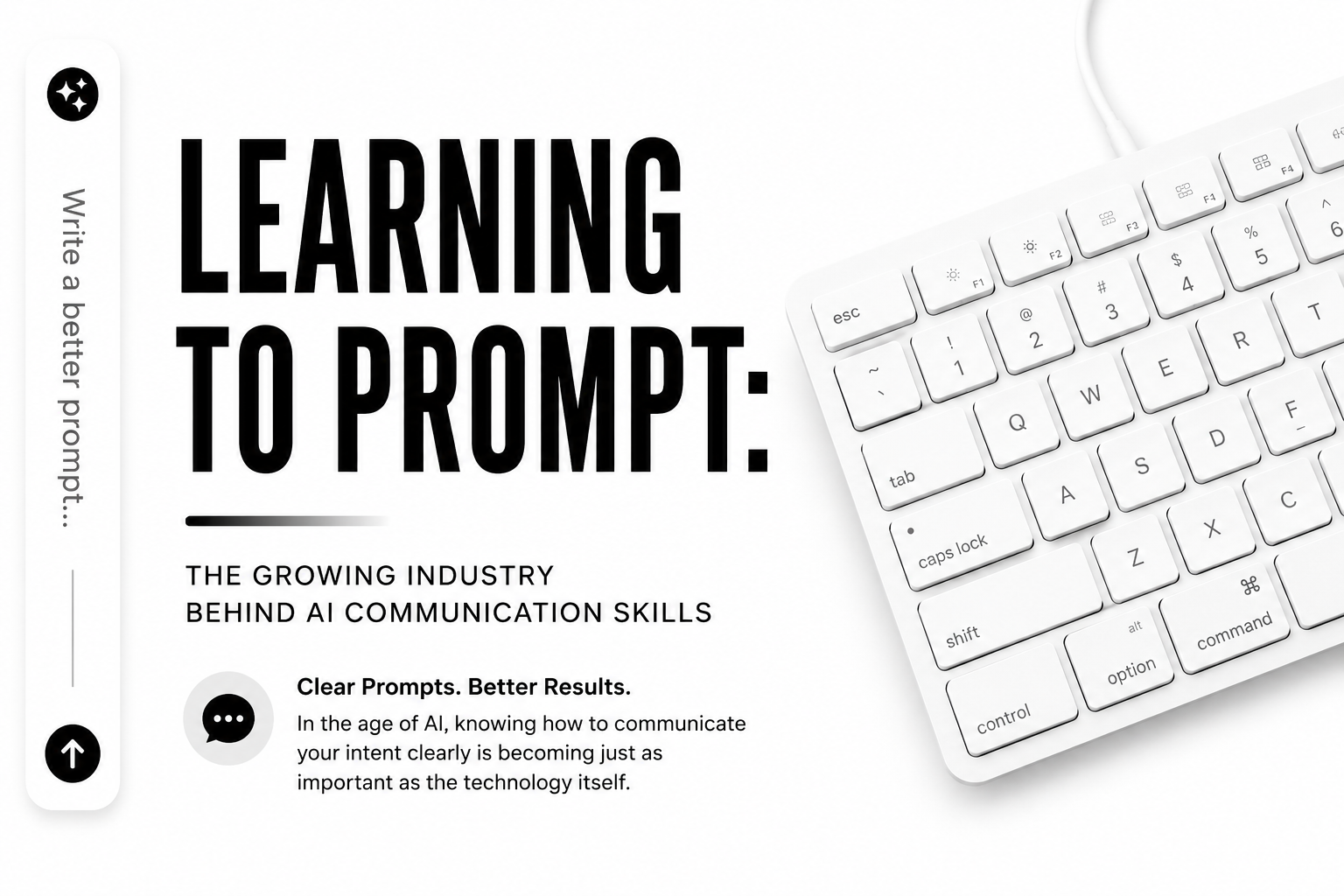
What began as experimentation has evolved into a growing industry focused on helping people communicate more effectively with intelligent systems. Courses, certifications, workshops, and online communities continue to appear as demand grows. Just a few years ago, few people had heard the term prompt engineering. Today, entire learning platforms are dedicated to teaching it.
More Than a Technical Skill
One of the biggest misconceptions about prompting is that it requires advanced technical knowledge. In reality, effective prompting often depends on communication rather than coding. Strong prompts clearly explain the objective, provide context, establish expectations, and define the desired outcome. These principles are not unique to artificial intelligence. They are the same principles that improve communication between people.
Prompting is less about learning a secret language and more about learning how to express ideas clearly and effectively. That is one reason prompting is becoming accessible to people from a wide range of backgrounds and industries. The skill is as much about critical thinking and communication as it is about technology. People who learn how to organize their thoughts, explain their goals, and provide useful context often receive better AI-generated results.
The Future of AI Communication
Artificial intelligence continues to evolve at an extraordinary pace. Future systems will likely become more powerful, more personalized, and more integrated into daily life. Despite these advancements, one thing is unlikely to change. AI systems still require direction, context, and instructions. Prompting serves as the bridge between human goals and machine capabilities.
As AI becomes increasingly common, people who learn how to communicate effectively with these systems may gain significant advantages in education, business, content creation, and problem-solving. The technology is becoming available to everyone, but the ability to use it effectively may become a key differentiator in the years ahead. The future may not belong to the people with access to the best tools alone. It may belong to the people who know how to use those tools most effectively.
Looking Ahead
The rise of prompting reflects a broader shift in the relationship between people and technology. For decades, success online depended largely on finding information. Increasingly, success may depend on directing intelligent systems to help create, organize, analyze, and apply information. Prompting is not simply an AI trend. It is becoming a modern communication skill. As educational resources, courses, and online communities continue to grow, more people are discovering that learning how to ask better questions, provide better context, and communicate goals clearly can dramatically improve their results.
The technology is becoming available to everyone. The people who learn how to communicate with it effectively may be the ones who benefit the most. Whether someone is creating content, running a business, studying for a class, developing software, or simply exploring new ideas, prompting is quickly becoming a practical skill with real-world value. As artificial intelligence continues to evolve, the ability to provide clear instructions, meaningful context, and well-defined goals may become one of the most important digital skills of the modern era.
The future of AI may not belong solely to the people building the technology. It may also belong to the people who know how to guide it.
AI Is Powerful, But It Is Not Always Right
While prompting can dramatically improve the quality of AI-generated responses, it is important to remember that artificial intelligence is not perfect. Even the most advanced AI systems can make mistakes, misunderstand instructions, generate inaccurate information, or present incorrect answers with confidence.
A well-written prompt can improve results, but it does not guarantee accuracy. Users should still verify important information, especially when dealing with topics involving health, finance, legal matters, education, or business decisions. Artificial intelligence can be an incredibly useful tool for research, brainstorming, organization, and productivity, but human judgment remains essential.
Understanding how to prompt effectively is only part of the equation. Learning when to question, verify, and fact-check AI-generated information may become just as important. As AI continues to evolve, successful users will likely be those who know how to combine the speed and capabilities of artificial intelligence with critical thinking and independent evaluation.
Resources for Learning More
Learn Prompting — https://learnprompting.org
OpenAI Academy — https://academy.openai.com
DeepLearning.AI — https://www.deeplearning.ai
Related Article
How Ordinary People Are Using AI to Build Real Income in 2026.
PictureThisInk® | Technology • AI • Innovation • Digital Culture
Explore more technology, artificial intelligence, innovation, digital culture, and future-focused coverage at PictureThisInk®. Stay connected as we continue covering the ideas, technologies, and trends shaping the future.
Website: https://www.picturethisink.com
Technology & AI Coverage: https://www.picturethisink.com/article