How Smart Glasses Are Changing the Way We Interact With Technology
Technology has always evolved toward greater convenience. From desktop computers to smartphones and from wired connections to wireless ecosystems, each generation of innovation has focused on reducing friction between people and information. Today, smart glasses represent the next step in that evolution.
Unlike earlier attempts that often felt experimental or futuristic, modern smart glasses are being designed with everyday usability in mind. They are no longer trying to replace smartphones or introduce entirely new forms of computing overnight. Instead, they are focused on enhancing daily life through hands-free communication, artificial intelligence, wearable cameras, real-time information, and seamless connectivity.
The Evolution of Smart Glasses
The first generation of smart glasses attracted significant attention but struggled to achieve mainstream adoption. Many early devices were expensive, limited in functionality, and often appeared more like technology demonstrations than practical products.
Over time, advancements in artificial intelligence, battery efficiency, miniaturized hardware, voice recognition, and camera technology have transformed what smart glasses can accomplish. Today's devices focus less on novelty and more on utility.
Rather than overwhelming users with screens and complex interfaces, modern smart glasses emphasize convenience. They allow users to capture photos, record videos, listen to audio, receive information, and communicate without constantly reaching for a smartphone.
This evolution reflects a larger trend across the technology industry. Consumers increasingly value products that simplify everyday experiences rather than adding unnecessary complexity.
Artificial Intelligence Moves Into Wearable Technology
One of the biggest changes driving the growth of smart glasses is artificial intelligence. AI has rapidly become part of everyday technology, appearing in smartphones, search engines, productivity tools, smart home devices, and digital assistants.
Smart glasses are now extending those capabilities into wearable technology. Voice-powered AI assistants can answer questions, provide reminders, offer recommendations, translate conversations, and deliver useful information in real time. Instead of opening multiple apps or navigating complex menus, users can simply ask for assistance naturally through voice interaction.
The result is a more seamless relationship between people and technology. Information becomes available when needed without requiring constant screen engagement. As AI continues to improve, wearable devices may become one of the most natural ways to access digital assistance throughout the day.
Ray-Ban Meta Brings Wearable AI Into Everyday Life
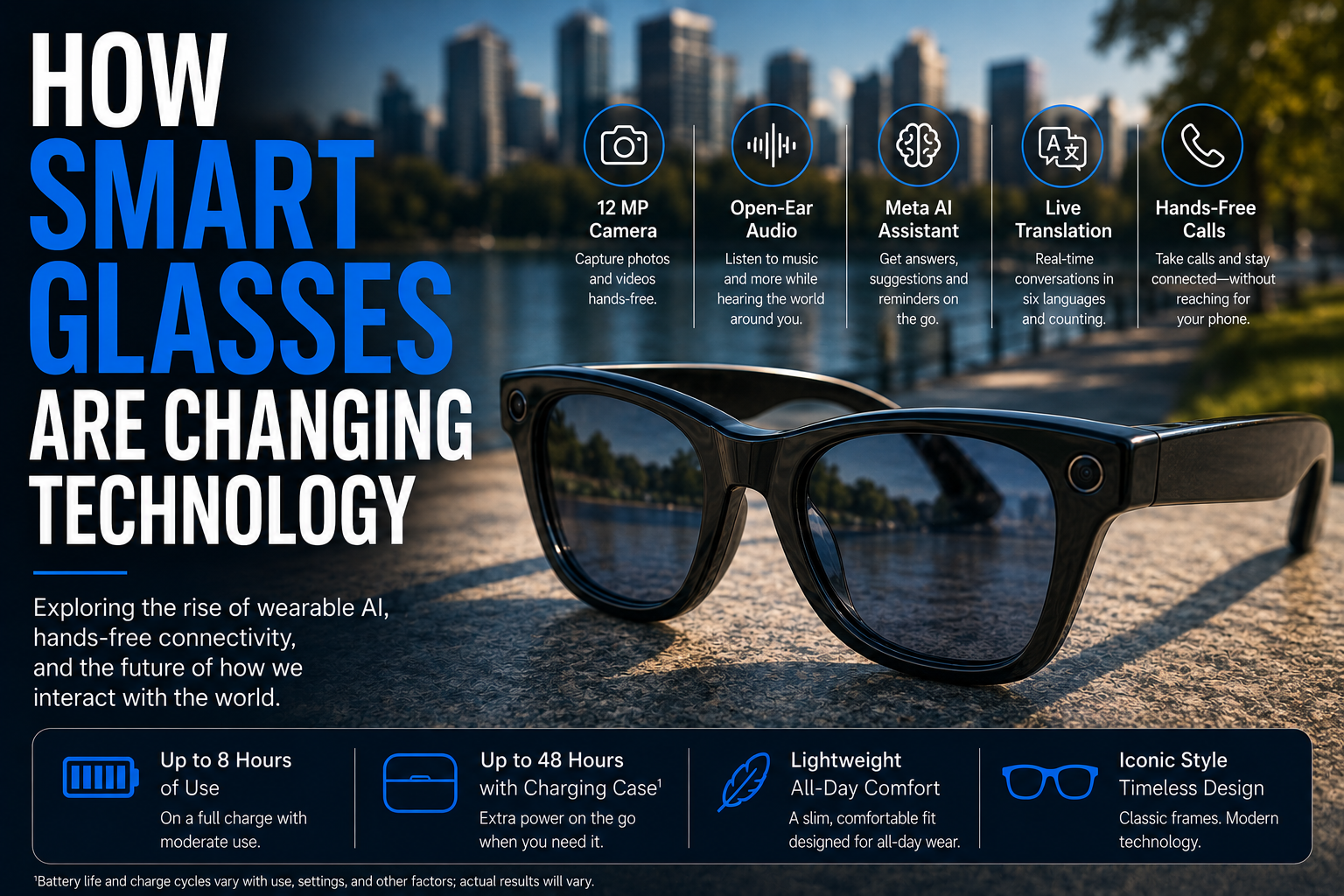
One of the most visible examples of this shift is Ray-Ban Wayfarer (Gen 2) Smart Glasses with Meta AI.
Combining iconic eyewear design with advanced technology, the latest generation of Ray-Ban Meta glasses demonstrates how wearable devices are becoming more practical and accessible for everyday consumers. The glasses feature Meta AI integration, allowing users to ask questions, receive suggestions, set reminders, and interact with artificial intelligence through natural voice commands.
Real-time language translation capabilities further expand their usefulness by helping users communicate across multiple languages without requiring a separate device. The inclusion of an ultra-wide 12 MP camera allows users to capture photos and videos hands-free while remaining present in the moment.
Improved open-ear speakers provide rich audio while allowing users to remain aware of their surroundings. This balance between connectivity and awareness represents one of the key advantages of modern smart glasses. Battery improvements have also made wearable technology more practical, making all-day use increasingly realistic for consumers.
Why Design Matters
One of the lessons learned from earlier wearable technology products is that design matters just as much as functionality. People wear glasses as part of their personal style. If a product feels uncomfortable, bulky, or visually distracting, adoption becomes difficult regardless of how advanced the technology may be.
Companies entering the smart glasses market increasingly understand that successful wearable devices must feel natural. They must fit seamlessly into daily routines and reflect the preferences of the people wearing them. This emphasis on design is one reason why established eyewear brands have become important participants in the wearable technology space.
The Benefits of Hands-Free Technology
Hands-free technology continues to gain popularity because it aligns with how people naturally move through the world. Whether taking a phone call while walking, listening to music during a commute, capturing a memorable moment, or accessing information while traveling, consumers increasingly value technology that allows them to remain engaged with their surroundings.
Smart glasses reduce the need to constantly check a smartphone screen. Instead, users can interact with technology through voice, audio, and subtle wearable features. This creates a more fluid experience that supports productivity, communication, and convenience without demanding constant attention.
For many users, that balance may prove more valuable than adding additional screens or increasingly complex interfaces.
What Smart Glasses Mean for the Future
The future of wearable technology is unlikely to be defined by dramatic science-fiction experiences. Instead, it will be shaped by practical improvements that make everyday interactions simpler and more efficient. Smart glasses represent a growing movement toward technology that supports human behavior rather than competing for attention.
As AI capabilities continue to expand, smart glasses may become an important bridge between the digital and physical worlds. Their ability to provide information, communication, entertainment, and assistance without requiring constant screen interaction positions them as one of the most promising consumer technology categories to watch.
The question is no longer whether wearable technology will become more intelligent. The question is how seamlessly it can integrate into everyday life. Smart glasses may be providing the answer.
Continue Exploring PictureThisInk®
Contact PictureThisInk®
https://www.picturethisink.com/contact
About PictureThisInk®
PictureThisInk® is an independent digital media publication covering technology, artificial intelligence, innovation, cybersecurity, digital culture, consumer technology, business technology, and emerging trends. Through original reporting and editorial analysis, PictureThisInk® explores the ideas, technologies, and opportunities shaping the future of modern life.