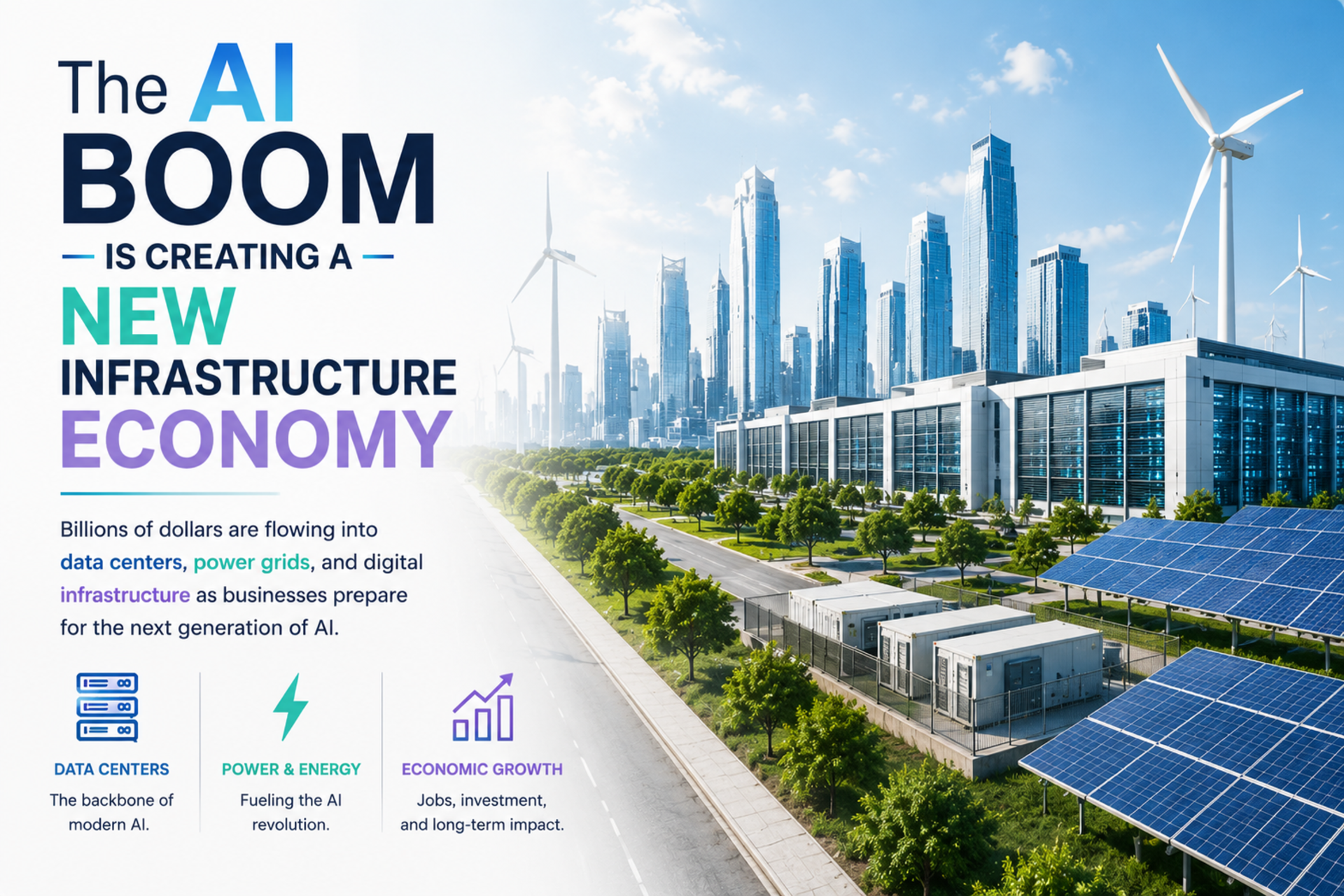
The AI Boom Is Creating a New Infrastructure Economy
Billions of dollars are flowing into data centers, power grids, and digital infrastructure as businesses prepare for the next generation of artificial intelligence.
The Infrastructure Behind Artificial Intelligence
Artificial intelligence has rapidly evolved from an emerging technology into one of the most influential economic forces of the decade. Only a few years ago, AI was often viewed as an experimental tool with enormous potential but limited real-world adoption. Today, that perception has changed dramatically. Businesses use AI to automate repetitive tasks, improve customer service, accelerate scientific research, assist software developers, generate digital content, analyze medical information, strengthen cybersecurity, and streamline daily operations. Consumers interact with AI every day by asking virtual assistants questions, creating images with text prompts, translating languages, organizing documents, and receiving personalized recommendations. As these technologies continue becoming more capable, many people naturally focus on the software itself. However, one of the biggest stories shaping the future of artificial intelligence has little to do with software at all.
Behind every AI-generated response is an enormous physical network that most people will never see. Every conversation with an AI assistant, every generated image, and every automated recommendation depends on thousands of powerful processors operating inside massive data centers spread across the world. These facilities contain advanced graphics processors, sophisticated networking equipment, industrial cooling systems, backup generators, battery storage, and enough computing power to perform trillions of calculations every second. While AI often feels invisible, the infrastructure supporting it is becoming one of the largest construction and investment opportunities of the modern economy.
A New Race Has Quietly Begun
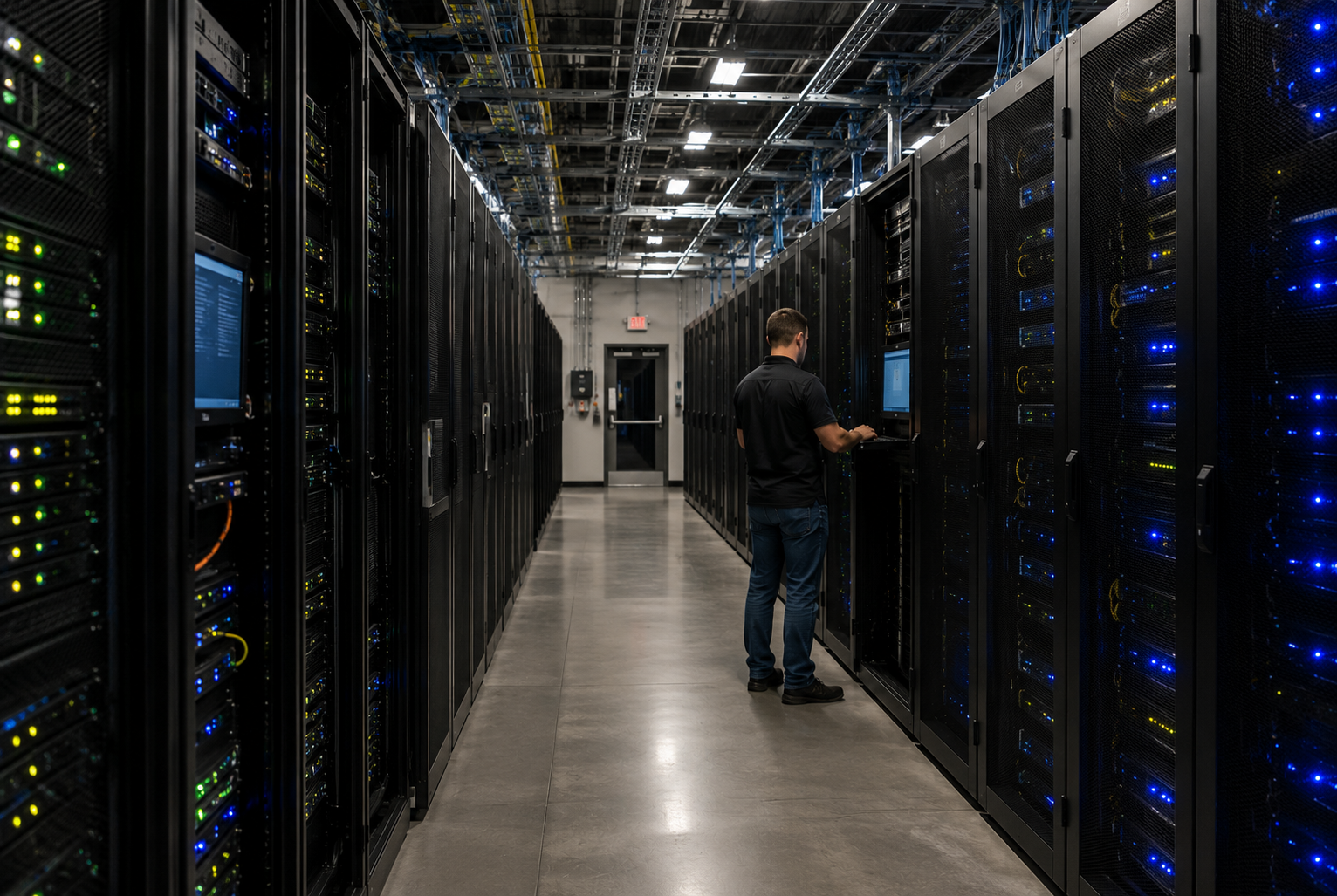
Much of the public conversation surrounding artificial intelligence focuses on which company has the smartest chatbot or the most advanced language model. Yet behind the scenes, another competition is unfolding—one that may ultimately prove even more important. Companies are no longer competing solely to build better AI. They are competing to build the infrastructure capable of supporting it.
Billions of dollars are now flowing into data centers, electrical grids, networking equipment, renewable energy projects, and advanced cooling technologies. This investment represents a dramatic shift in how businesses view artificial intelligence. Instead of treating AI as another software product, organizations increasingly recognize that it requires physical infrastructure on a scale rarely seen outside major transportation or energy projects. The companies investing today are not simply preparing for next year. They are building facilities designed to support decades of technological growth.
Recent announcements illustrate how quickly this transformation is accelerating. Major technology companies continue expanding their global computing capacity, while businesses outside the traditional technology industry are also exploring opportunities connected to AI infrastructure. Manufacturers, energy providers, commercial real estate developers, and industrial suppliers increasingly recognize that artificial intelligence is becoming much more than software. It is becoming a new economic foundation.
Why Data Centers Matter More Than Ever
For decades, data centers quietly powered the internet without attracting significant public attention. They stored websites, hosted applications, processed financial transactions, and supported cloud computing services. Most people never thought about where their online information was stored because these facilities simply worked behind the scenes. Artificial intelligence has changed that completely.
Today's AI systems require vastly more computing power than traditional internet services. Instead of retrieving stored information, modern AI models actively generate new responses by performing billions of mathematical calculations almost instantly. Training one advanced language model can require thousands of specialized processors working together continuously for weeks or even months. Once that model becomes available to the public, it continues consuming significant computing resources as millions of users interact with it every day.
Data centers have transformed from background technology into strategic infrastructure. Governments compete to attract them because they create jobs, encourage investment, and strengthen digital economies. Investors increasingly view them as long-term infrastructure assets, similar to airports, rail systems, or power plants. Cities evaluate whether local utilities can support them, while construction companies expand specialized divisions dedicated entirely to AI-related development.
Electricity Has Become the New Competitive Advantage
Perhaps the biggest surprise of the AI revolution is that one of its greatest challenges is not writing better software. The challenge is generating enough electricity to keep that software running.
Artificial intelligence requires extraordinary amounts of energy. Every new generation of processors becomes faster and more capable, but those improvements often increase electricity demand as organizations build larger and more sophisticated AI systems. Analysts expect global data center power consumption to rise significantly over the next decade as businesses integrate AI into healthcare, finance, education, manufacturing, logistics, entertainment, and scientific research.
Electricity is becoming one of the most valuable resources in the digital economy. Utility companies are expanding transmission networks to prepare for future demand. Renewable energy developers continue investing in large-scale solar and wind projects capable of supporting AI facilities. Battery storage technologies are receiving increased attention, while nuclear energy is once again becoming part of discussions surrounding reliable, around-the-clock power generation. Technology companies increasingly understand that the future of artificial intelligence depends not only on processors and software but also on access to dependable energy.
Beyond Silicon Valley
The AI infrastructure boom extends far beyond the technology industry. Every new data center creates demand for architects, civil engineers, electricians, steel manufacturers, heavy equipment operators, cybersecurity specialists, HVAC technicians, network engineers, and construction workers. Large facilities often require years of planning before construction even begins. Roads must be expanded, fiber-optic connections installed, electrical substations upgraded, and water systems carefully evaluated before the first server arrives.
What appears to be a technology investment often becomes a major regional economic development project. Communities compete for these facilities because they generate long-term tax revenue, create skilled jobs, and encourage additional business investment. The ripple effects extend well beyond technology companies, benefiting suppliers, contractors, manufacturers, and local businesses throughout the surrounding region.
The growing interest from companies outside Silicon Valley demonstrates how broadly artificial intelligence is reshaping the global economy. Recent reports involving businesses such as Honda exploring opportunities connected to data center development highlight a larger trend. Organizations that once focused entirely on manufacturing, transportation, or industrial production increasingly recognize that digital infrastructure may become just as important as physical factories. Artificial intelligence is creating opportunities across industries that only a few years ago appeared completely unrelated to software development.
Building the Foundation for Tomorrow
History has shown that every major technological breakthrough depends on infrastructure. Railroads transformed commerce because tracks connected distant cities. Highways revolutionized transportation by allowing goods and people to move more efficiently. The internet reshaped communication because fiber-optic networks connected billions of devices around the world. Artificial intelligence is following that same pattern.
The software may capture the headlines, but infrastructure determines how far the technology can ultimately go. Without reliable electricity, advanced networking, modern data centers, and continued investment, even the most sophisticated AI systems cannot reach their full potential. As businesses, governments, and communities continue preparing for the future, they are investing not only in artificial intelligence itself but also in the physical systems capable of supporting the next generation of innovation.
The AI revolution is no longer simply about creating smarter software. It is influencing how cities grow, how industries invest, how electrical grids expand, and how businesses prepare for an increasingly digital economy. Beneath every AI-generated response lies an invisible world of infrastructure working continuously behind the scenes. While consumers experience the convenience of intelligent technology, an entirely new economic engine is being constructed one data center, one power line, and one investment at a time. The companies helping build that foundation today may ultimately shape the future of artificial intelligence for decades to come.
Related Article
Continue exploring the infrastructure powering the digital world:
The Digital World Has a Physical Backbone: Inside the Rise of Data Centers