Cincinnati Art Museum Opens Its First Permanent Fashion Gallery

Published by PictureThisInk · Powered by MisherTech
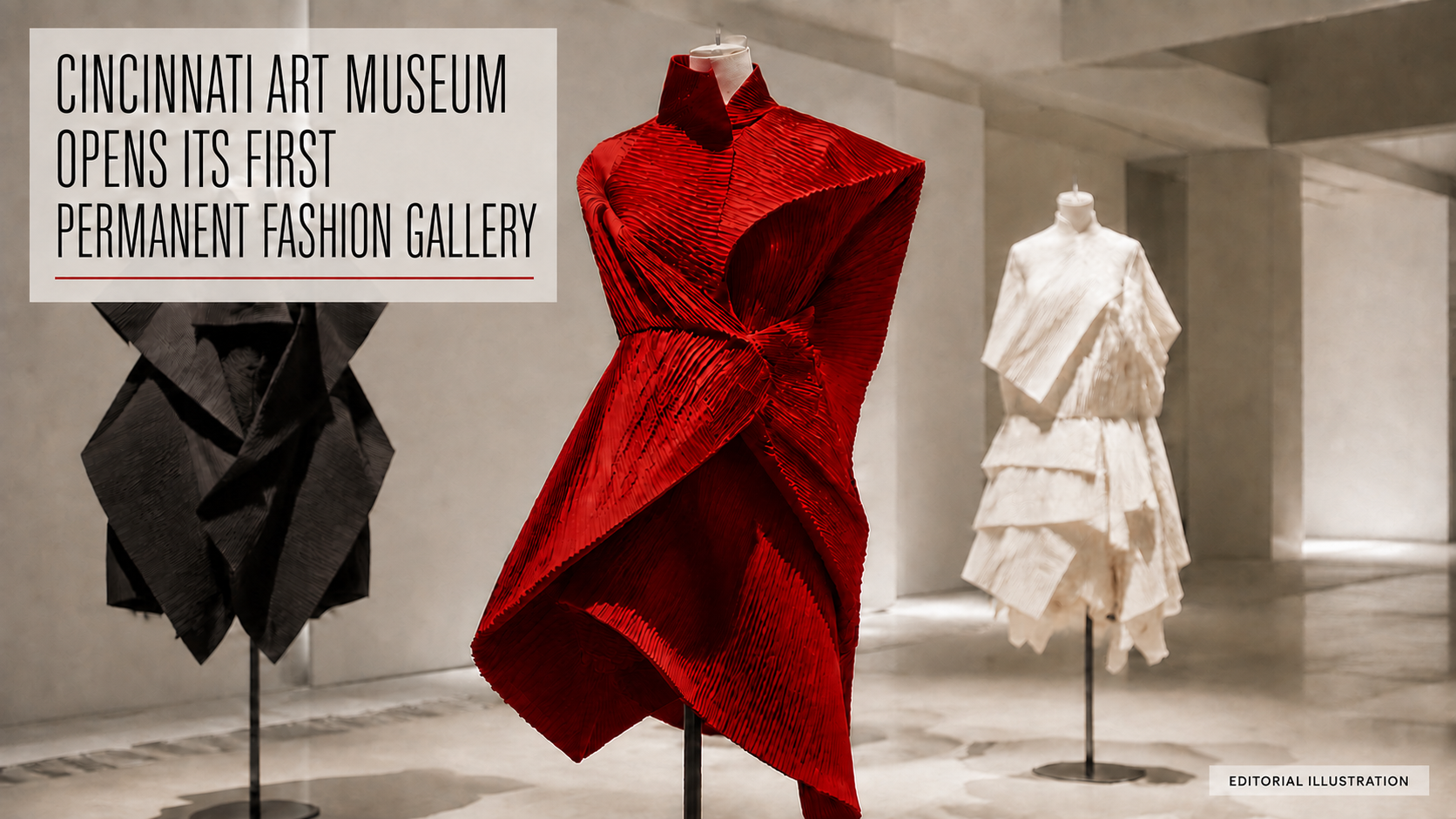
A garment can carry engineering, movement, identity, history, and sculpture in the same piece. Cincinnati is giving that kind of design a permanent room of its own.
Fashion Moves Into a Permanent Gallery
The Cincinnati Art Museum opens the Mary W. Baskett Gallery on August 25, its first gallery permanently dedicated to displaying and interpreting fashion and textiles.
The space is more than a temporary exhibition. It gives the museum a continuing location where clothing, accessories, and fiber arts can be presented as part of its broader art collection. According to the museum’s August 24 announcement, the works will rotate regularly and explore the connections between fashion and other art forms.
Permanence changes the message: fashion is not visiting the museum; it belongs inside the museum’s story of art and design.
The First Presentation Begins With Gesture and Meaning
The gallery’s opening feature, Gesture and Meaning, is drawn entirely from Mary W. Baskett’s collection of avant-garde fashion from Japan. The collection includes pieces by designers such as Issey Miyake, Rei Kawakubo, and Yohji Yamamoto.
Their work helped expand the language of fashion through unconventional structure, volume, pleating, asymmetry, and the relationship between fabric and the body. Inside a museum, a viewer can study those decisions without the speed of a runway or the pressure of a store.
The clothing becomes a record of experimentation: how a flat textile can be folded, cut, draped, and engineered into space.
Mary W. Baskett Built More Than a Collection
The gallery is named for a Cincinnati curator, educator, gallerist, collector, and philanthropist whose work connected Western and Japanese art. Baskett served as the museum’s curator of prints from 1965 to 1971 and helped build its collection of twentieth-century Japanese prints.
In 2025, she planned a $5 million gift supporting the museum’s fashion arts and textiles collection. The museum says the gift led to the gallery and will also endow its curator of fashion arts and textiles position. Her Japanese fashion collection and art-history research are included with the gift.
This is an important piece of museum building. A permanent gallery needs objects, but it also needs scholarship, curatorial time, and resources for the collection to remain active.
A 15,000-Work Collection Gains a Clearer Voice
The Cincinnati Art Museum says its fashion arts and textiles collection contains approximately 15,000 works, including dress, accessories, and fiber arts from around the world.
A dedicated gallery does not mean all those objects can be shown at once. Textiles are sensitive to light, gravity, and time, so rotations can protect the works while allowing new stories to appear. That rhythm can make the gallery feel less like a fixed display and more like a changing design conversation.
The museum also offers free general admission, although it notes that pricing for individual exhibitions may vary. Visitors should check current museum information before making plans.
Why It Matters
Design shapes daily life, yet the objects closest to the body are often treated as decoration rather than serious creative work. A permanent fashion gallery makes room for the intelligence inside material, pattern, construction, and cultural exchange.
The Mary W. Baskett Gallery also shows how one collector’s long-term attention can become public infrastructure. Her collection will not remain only a private archive; it will support changing presentations, research, and future encounters between audiences and design.
The best museum rooms do more than preserve objects. They help people recognize the ideas that were already stitched into them.
Sources
Cincinnati Art Museum — First dedicated fashion gallery announcement, August 24, 2026
Cincinnati Art Museum — Official museum website and visitor information
Comments
No approved comments yet. Be the first.