
XPENG Robotics Raises More Than $900 Million to Move Humanoids Toward Mass Production
Published by PictureThisInk · Powered by MisherTech
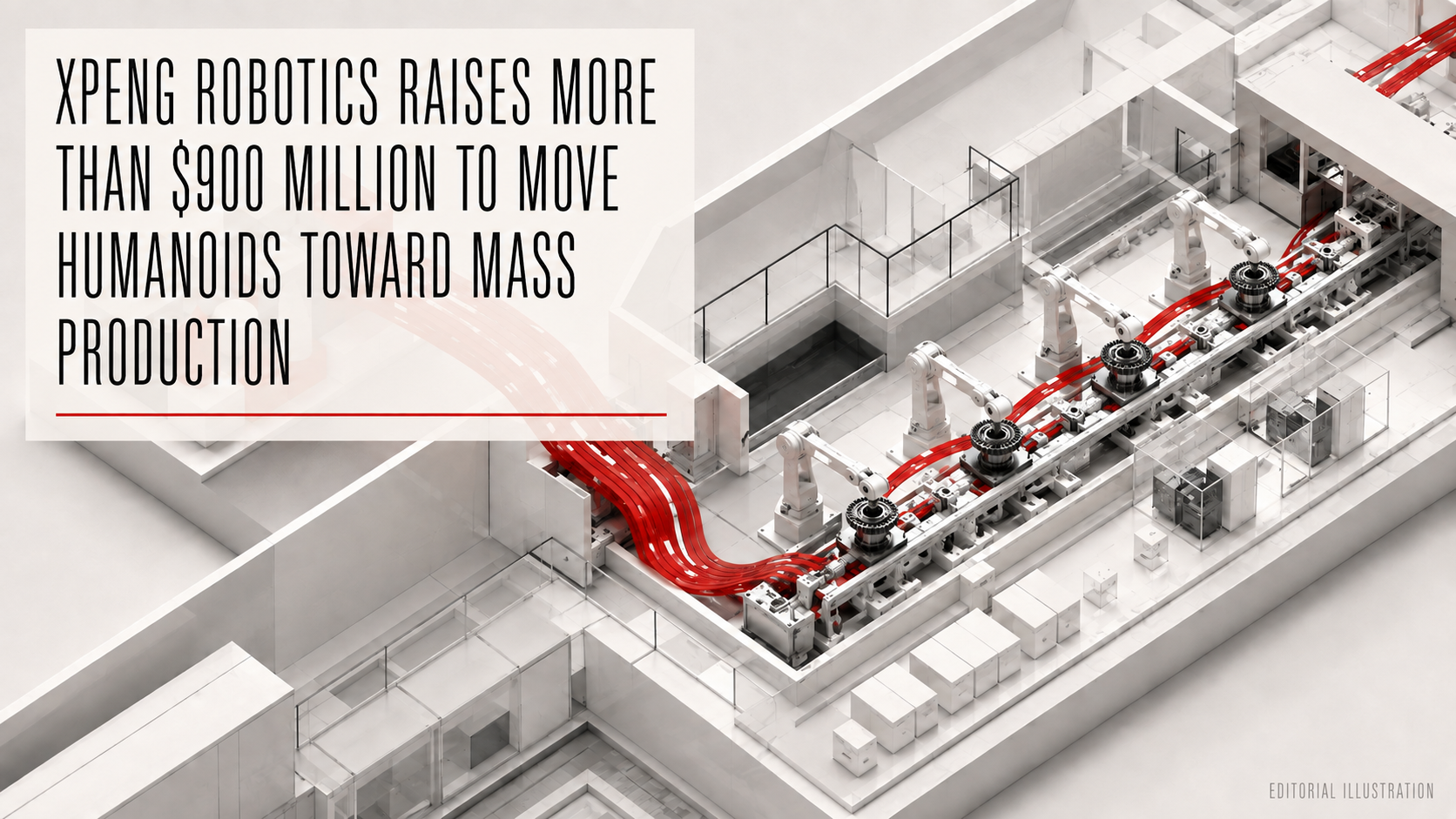
The difference between a remarkable robot demonstration and a real robotics business is the ability to build the machine repeatedly, support it and give it work worth doing.
A Major Bet on Physical AI
XPENG announced on August 24 that its robotics business raised more than $900 million in its first funding round. The company said the deal values the unit at more than $6.3 billion after the investment.
According to XPENG’s August 24 announcement, the round was led by IDG Capital, with participation from Gaorong Ventures and strategic investors including Tencent and Alibaba. XPENG will remain the controlling shareholder. The size of the round shows that investors are not treating humanoid robots as a small side project.
The Money Is Meant to Build More Than Hardware
Robotics development is expensive because the physical machine is only one part of the system. A humanoid also needs perception, movement planning, training data, safety systems and software that can improve without making the robot unpredictable.
XPENG said the new capital will support hardware and software research, the training and refinement of Physical AI models, the collection of high-quality data, mass-production facilities and international expansion. Reuters’ August 24 report described the financing as a record round in China’s embodied-AI sector. The business challenge is to connect intelligence, manufacturing and a practical use case in one dependable product.
Why an Automaker Has an Advantage
XPENG is best known for electric vehicles, but modern vehicles and humanoid robots share important technical problems. Both must interpret their surroundings, make decisions from sensor data, control complex hardware and operate safely around people.
An automaker also has experience with suppliers, production quality and service networks. Those capabilities could matter as much as a dramatic AI model when the goal is to build physical machines at scale.
The crossover is not automatic. A robot that walks through a store or factory faces different risks from a vehicle on a mapped road. Still, companies that already know how to combine software with large, safety-sensitive machines may begin with a useful manufacturing foundation.
IRON Is Moving Toward a Commercial Deadline
XPENG says it plans to begin mass production of its IRON humanoid by the end of 2026, with initial uses expected in locations such as stores and campuses. Reuters reported that the company is targeting production of 1,000 units per month by year-end and broader commercial sales in 2027.
Those are company plans, not completed results. The real test will be whether XPENG can produce robots consistently, keep operating costs manageable and demonstrate that customers receive measurable value from deploying them. A funding announcement can accelerate the work, but it cannot replace proof from daily operation.
Why It Matters
The round gives XPENG’s robotics business enough capital to pursue an unusually ambitious transition: from prototype development to a repeatable production operation.
If the company succeeds, the important breakthrough may not be a single human-like movement. It may be a system for producing, training and maintaining useful robots at scale. If it falls short, the investment will still reveal how difficult that transition remains.
Humanoid robotics is entering the stage where investors will expect factories, customers and reliable results—not only impressive demonstrations.
Sources
XPENG Investor Relations — robotics funding announcement, August 24, 2026
Reuters — XPENG’s robotics unit valued above $6.3 billion after funding round, August 24, 2026
Comments
No approved comments yet. Be the first.
Related Articles
5 Pixel Watch 5 Updates That Aim to Make Everyday Life Easier
 PictureThisInk Editorial· 3 min read
A New Cultural Space Opens in Durham
PictureThisInk Editorial· 2 min read
AI Cyber Risk Just Became a Boardroom Issue
PictureThisInk Editorial· 4 min read