
The Robot Games Are Becoming a Test Lab for Useful Humanoids
Published by PictureThisInk · Powered by MisherTech
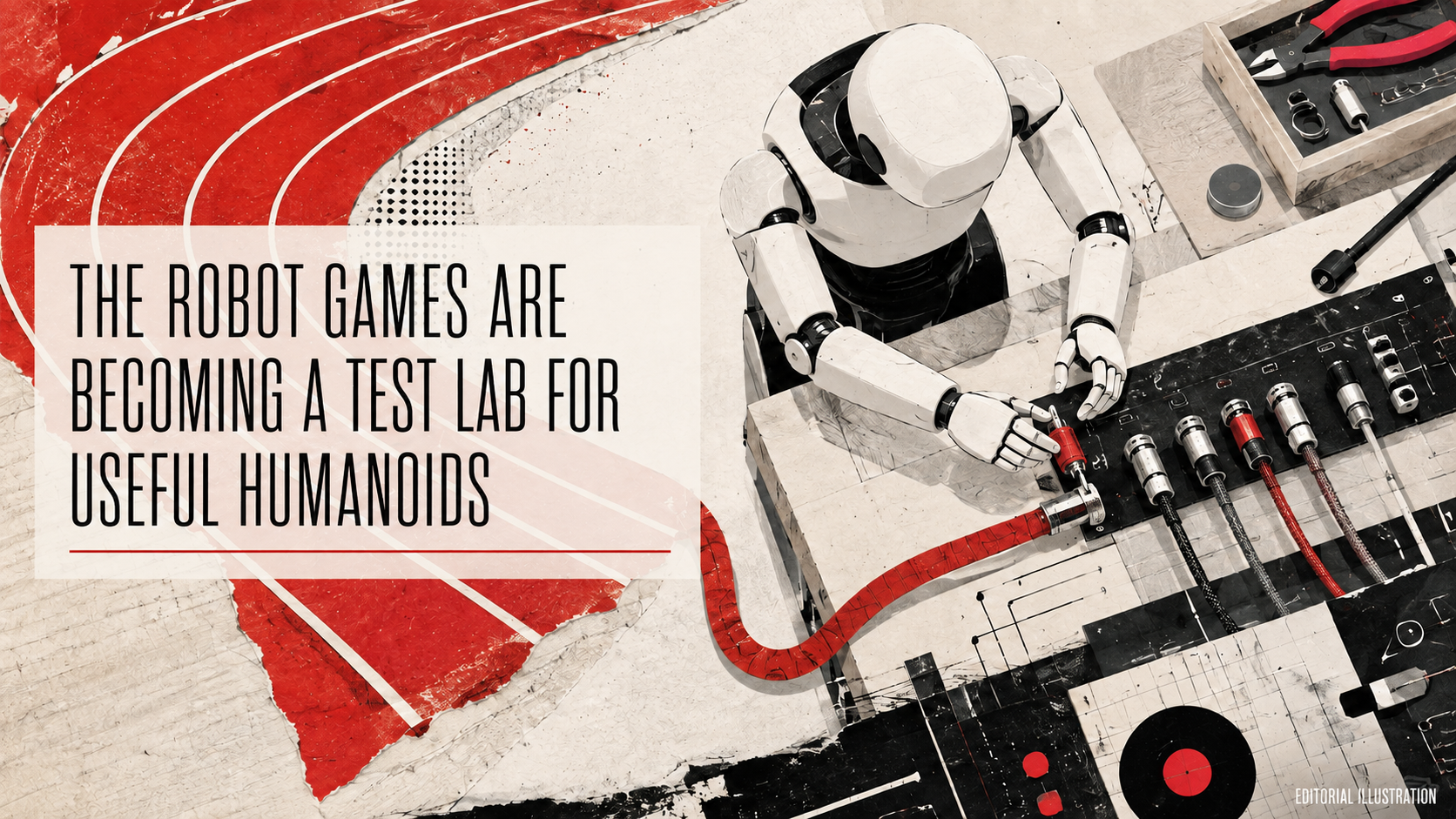
A robot that can sprint across a finish line is impressive. A robot that can recognize the right cable, align it correctly and recover when the first attempt fails may be far more useful.
The Real Test Is Moving Beyond the Show
The second World Humanoid Robot Games opened in Beijing on August 22 with 666 teams, 2,056 robots from 16 countries and 51 competition events. The scale alone makes the event a striking display of how quickly humanoid robotics is expanding.
But the most important story is not happening on the running track. According to Xinhua’s August 22 report, scenario-based events are being staged in settings designed to resemble factories, hotels and model homes. The goal is shifting from showing that robots can move to finding out whether they can do something reliably once they arrive.
Hands May Matter More Than Speed
This year’s competition added challenges centered on robotic hands. Reuters reported on August 22 that precision tasks include tightening screws, opening bottles and picking up beads with tweezers.
Those actions sound ordinary because people perform them without much thought. For a machine, they demand visual perception, pressure control, balance and the ability to adjust when an object moves. Useful dexterity is not one skill. It is a chain of small decisions that must work together.
That is why a cable-plugging test can reveal more about commercial readiness than a dramatic race. The robot has to identify the connection, approach it at the correct angle, apply enough force and recognize whether the job succeeded.
Real Rooms Create Real Problems
A controlled demonstration can be designed around a robot’s strengths. A workplace cannot. Floors vary, people interrupt, objects are misplaced and instructions change. These small uncertainties are where impressive prototypes often become slow or unreliable.
The organizers’ decision to move scenario tasks toward realistic work environments matters because it introduces the kind of variation machines will face outside a laboratory. Reuters’ August 23 analysis highlighted factory, restaurant, office and emergency-response challenges, including cable connection, object recognition and precise alignment. A practical robot must do more than complete a rehearsed motion; it must notice when reality does not match the plan.
Competition Can Expose Weaknesses Faster
Public competition creates pressure that a private demonstration may not. Teams work under the same general conditions, failures become visible and engineers can compare different approaches to the same problem.
That does not turn a competition result into proof that a robot is ready for a home, hospital or factory. Performance may still depend on remote control, carefully prepared surroundings or specialized rules. Reliability, safety, cost, maintenance and useful operating time remain separate questions.
The event is valuable precisely because it makes some of those limits harder to hide. Falling, missing an object or needing another attempt is useful information when the purpose is to build a better machine.
Why It Matters
Humanoid robots are often promoted through the moments that look best on video. The harder and more meaningful work is quieter: grasping unfamiliar objects, completing repetitive tasks and recovering safely from mistakes.
The 2026 games suggest the industry understands that difference. Spectacle may attract attention, but dependable performance will determine whether humanoid robots become useful tools. The future of robotics will not be decided by the fastest machine on the track. It will be decided by the machine people can trust to finish the ordinary job.
Sources
Xinhua — 2nd World Humanoid Robot Games open in Beijing with over 2,000 robots, August 22, 2026
Reuters — From science fair to strategic showcase: a decade of China’s robot games, August 22, 2026
Reuters — Robots can outrun humans, but can they plug in a cable?, August 23, 2026
Comments
No approved comments yet. Be the first.
Related Articles
5 Pixel Watch 5 Updates That Aim to Make Everyday Life Easier
 PictureThisInk Editorial· 3 min read
A New Cultural Space Opens in Durham
PictureThisInk Editorial· 2 min read
AI Cyber Risk Just Became a Boardroom Issue
PictureThisInk Editorial· 4 min read