
Starcloud announced that it raised $250 million in an extension to its Series A financing.
Published by PictureThisInk · Powered by MisherTech
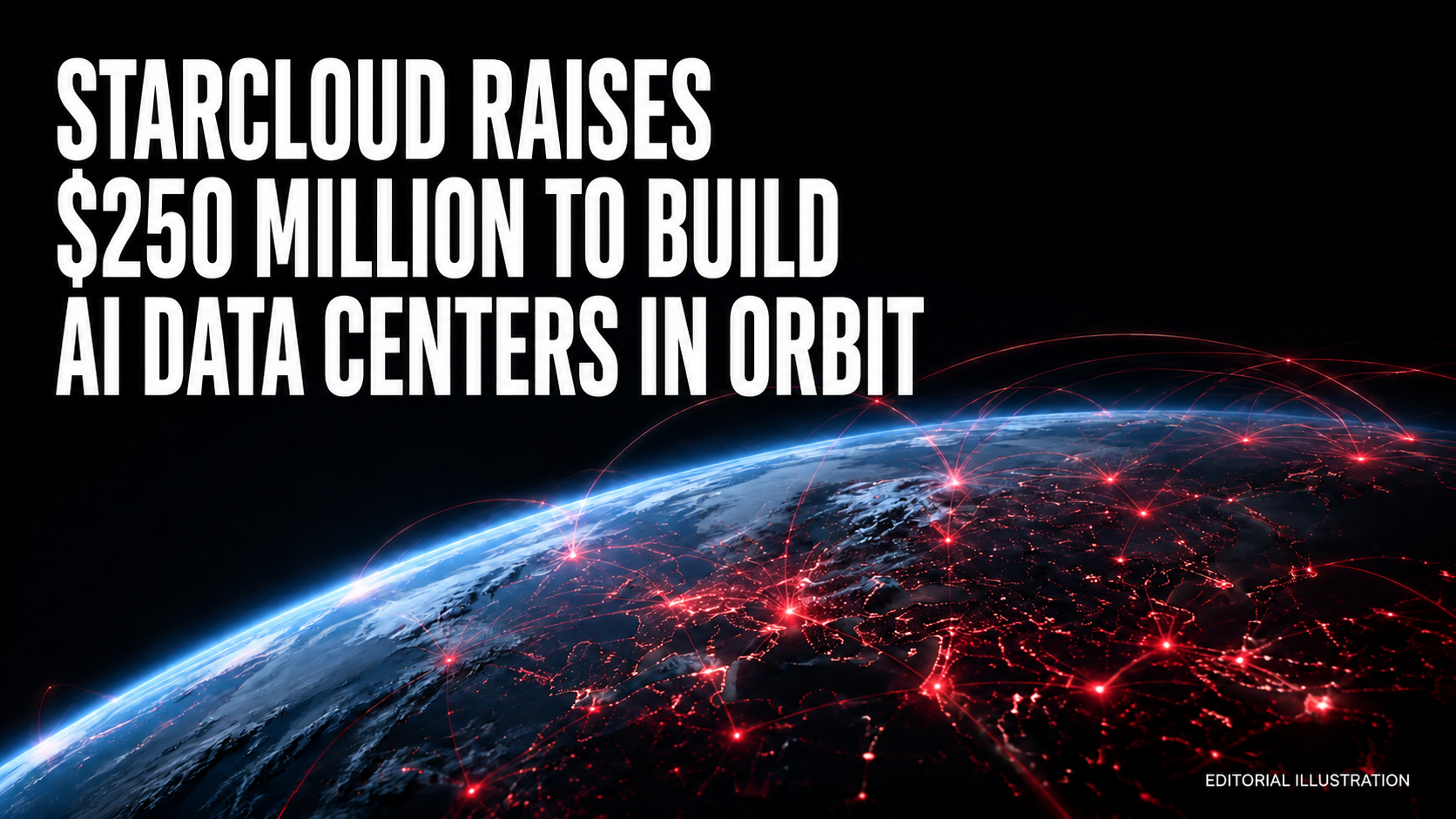
The artificial-intelligence industry needs enormous amounts of computing power. Most companies are responding by building larger data centers on Earth. Starcloud is pursuing a more unusual answer: move part of the computing infrastructure into orbit.
A $250 Million Bet on Computing in Space
On August 21, 2026, Redmond, Washington startup Starcloud announced that it raised $250 million in an extension to its Series A financing. The deal gives the company a reported $2.3 billion post-money valuation and brings its total capital raised since its 2024 founding to $450 million.
The round was led by Manhattan West. Nvidia and Cisco Investments participated alongside existing investors including Benchmark and EQT.
The money does not prove orbital data centers will work at scale. It proves that major investors believe the idea is worth testing.
Why Put Computing Hardware in Orbit?
Data centers require electricity, land, cooling, networking, and reliable physical infrastructure. AI growth has increased pressure on all of those resources.
Space offers one obvious attraction: solar energy. A spacecraft in the right orbit can receive sunlight for long periods without using land on Earth. Orbital computing could also process information closer to satellites that collect it, reducing the need to send every piece of raw data to the ground before analysis begins.
Those advantages do not make the idea easy. Launching hardware is expensive. Electronics must survive radiation and extreme conditions. Heat cannot be removed with ordinary air conditioning because space has no surrounding air to carry it away. Large radiators are needed to release heat.
Starcloud’s real challenge is making all of those systems work together at a cost customers are willing to pay.
From One Processor to Manufacturing Capacity
Starcloud says it placed an Nvidia H100 graphics processor in orbit aboard its Starcloud-1 satellite in November 2025. That mission gave the startup real flight experience with high-performance computing hardware outside Earth’s atmosphere.
The company and Nvidia are now collaborating on the Space-1 Vera Rubin Module, AI hardware designed to withstand radiation and other orbital conditions. Starcloud says future spacecraft are intended to serve as an early flight platform for the technology.
The new financing is notable because Starcloud is no longer describing only a laboratory demonstration. It is spending money on production capacity and future spacecraft, including a 100,000-square-foot manufacturing facility in Woodinville, Washington.
Manufacturing Is Where the Idea Gets Real
Building one successful prototype is different from producing reliable units repeatedly, integrating them with launch providers, and operating them as a service.
A company has to build the hardware, secure launches, manage radiation and heat, connect with customers, and deliver results at a competitive cost.
The biggest test is not whether an orbital data center sounds futuristic. It is whether the company can make thousands of ordinary engineering decisions work together reliably.
A Valuation Is Not a Guarantee
Starcloud’s reported $2.3 billion valuation is more than twice the $1.1 billion valuation reported when it raised $170 million in March. That increase shows strong investor interest in the overlap between AI infrastructure and space technology.
It does not prove that orbital data centers will become commercially successful. A private financing valuation represents the terms investors accepted in a particular funding round. It is not the same as annual revenue, profit, public-market value, or what the company would receive in a sale.
Why It Matters
The latest funding gives Starcloud more resources, experienced investors, and major technology collaborators. It also raises expectations.
The next phase will be measured less by the size of the idea and more by execution. Can the company build the hardware repeatedly? Can it secure launches? Can it deliver computing customers actually need at a competitive cost?
According to Starcloud’s August 21 announcement, the new capital will support manufacturing expansion, Nvidia engineering work, and future launch procurement.
Putting AI data centers in orbit sounds futuristic. The company’s value will depend on whether it can turn that future into working infrastructure.
Comments
No approved comments yet. Be the first.
Related Articles

600 Startups Just Walked Into Riyadh
 PictureThisInk Editorial· 4 min read
Big Ideas Meet in Boston Before They Meet the Market
PictureThisInk Editorial· 4 min read
Gatik Raises $200 Million to Scale Driverless Middle-Mile Delivery
PictureThisInk Editorial· 4 min read